
Customer reviews integrated into a homepage are an essential element of trust and directly influence user behavior. Positive testimonials can increase conversion rates, while negative reviews provide valuable feedback and highlight areas for optimization. Online reviews gain credibility when they are transparent, recent, and from verified customers.
Create a website
Your site in a flash thanks to artificial intelligence
- Intuitive site editor with AI features
- Image and text generator with SEO optimization
- Domain, SSL and email included
Why are customer reviews important?
Customers and website visitors often gain valuable information through reviews and testimonials, which allow them to learn about the experiences of other users before investing in a product, service or business. Unlike traditional commerce, a product sold online cannot be physically examined; customer reviews therefore fill this information gap. Buying online is convenient, fast and comfortable, but it also creates a certain distance. This is why many potential customers remain uncertain about the quality and usefulness of online offers.
If a website integrates evaluations or a comments areathis distance can be reduced: customers help each other in their purchasing decisions and provide information on the function, scope and added value of a product. It is also relevant to evaluate the site itself or comment on non-commercial content. The simple possibility of evaluation shows that you take into consideration the expectations of your users, which builds confidence. In addition, you actively involve visitors to your site by allowing them to comment on your offers or content.
THE customer reviews on your website also provide essential feedback: do the products meet expectations? Is the content attractive and does it provide real added value? This information is crucial for continuously optimizing your website and your offer.

What are the different types of assessments?
Customer reviews on a homepage can take many forms, from simple star ratings, inspired by the school rating system, to detailed comments or real testimonials. Some sites also allow users to express their opinion using icons (thumbs up or down) to indicate their feelings about content. Here are the main evaluation mechanisms:
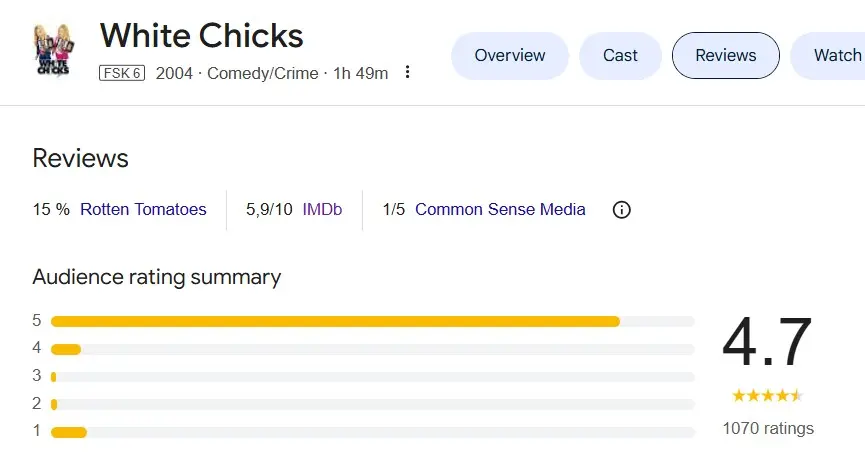
- Star Ratings : a simple way to express an opinion in one click. The five-star system has established itself as a standard on the Web ; one star indicates the worst rating, five full stars the best.
- Positive/negative votes : very fast and easy to use system, but limited. It is based on a “I like” or “I don’t like” scale and does not explain the reasons for the feelings expressed.
- Comments : they answer the question of “Why” an evaluation. Users can thus justify their opinion succinctly and make suggestions or proposals for improvement.

- Reviews : Reviews are mainly offered for products in online stores. First, Amazon built a vast base of reviews constantly enriched thanks to a huge user base for a multitude of products.

As the last example shows, a majority of users rated this review as “helpful”. Amazon offers, in addition to the possibility of writing detailed reviews, a function allowing you to indicate whether a review is constructive or not. So, a meta-evaluation system (evaluating the usefulness of an opinion) completes the system: it limits abuse linked to evaluations and acts as a control body. Another trust factor is added in this example, since Amazon identifies and verifies reviewer purchases.
Customer reviews for home pages: best practices
These examples show that there are many ways to implement an evaluation system. These options are not mutually exclusive and can be combined easily. The example of Amazon illustrates this well: a review is associated with a rating in the form of five stars.
In addition, it is possible to evaluate an opinion by comments or via a “Like” button. From these examples, we can identify several good practices :
- Reviews, ratings and comments must be authentic and come from real customers.
- It is not recommended to delete negative reviews or hide them. Instead, respond factually and offer courteous help.
- Encourage your users to share their opinions and encourage exchange. A large number of reviews reflects the popularity of your offer.
- The evaluation function must be visible and easy to use.
- It may be relevant to promote involvement and highlight active contributors.
- Regularly analyze ratings, comments and reviews. It is only in taking feedback seriously and learning from it that you will be able to improve the quality of your offers and the user experience.
Depending on the type of system chosen, there are several methods for adding reviews to a website. The simplest is to use the built-in functions of content management systems (CMS) or e-commerce platforms. Many already offer a dedicated function, or at least separately installable plugins to manage reviews. There are also generator tools which automatically create the necessary HTML code in just a few clicks, ready to copy and paste. Finally, it remains possible to add manually star ratings.
Website with domain name
Create your website in minutes
- Professional templates
- One-click design editing
- Domain, SSL and email
Plugins
Most CMS and e-commerce platforms offer practical multi-purpose solutions allowing you to display different review systems: stars, points, circles or other icons. Many tools also offer the possibility of integrating rich snippets in the Google SERPs. Installation is generally very simple, depending on the CMS used, and the offer ranges from free plugins to more complete premium solutions. Just for the most popular CMS, WordPress, there are a multitude of review plugins and testimonials.
Plugin-based solutions represent an effective approach for the majority of CMS, thanks to their versatility, wide range of features and wide availability. They are also easy to integrate into a website, even for beginners, depending on the CMS and plugin chosen.
Online code generator tools
For those who want a simple solution to integrate reviews on a website without writing code, it is possible touse a generator tool. An example is theEasy Icon Editor by Noun Projectwhich allows you to customize existing star icons. The code is then automatically generated and can be copied and pasted. In addition to classic stars, it is possible to use your own graphics.
You can also adapt the text or change the number of stars. However, due to their limited customization options, these solutions are best suited to simple websites. Another common drawback is that the backend often requires additional configuration (e.g. via a specific PHP script) to correctly save user input.
Integration by custom code
It is of course possible to manually write the code to integrate reviews into a website. For a simple star system, a scale of five selectable stars can be set up with HTML, CSS and a little JavaScript. The stars can be displayed in SVG or Unicode and activated with a click. JavaScript then saves the chosen evaluation (for example in a form field), which can be processed or stored on the server side. To display dynamic ratings with feedback or average values, it is necessary to connect the system to a database (e.g. MySQL) and add server-side logic (PHP, Node.js or Python).
Here's a simple example of a CSS class for a star rating system. However, this code only concerns displaying the rating systemthe script allowing read and save user data still needs to be added.
1  .rating {
2      unicode-bidi: bidi-override;
3      direction: rtl;
4  }
5
6  .rating span {
7      display: inline-block;
8      width: 1.1em;
9      font-size: 2.8em;
10      color: #ccc;
11      cursor: pointer;
12      text-shadow: 0 0 1px #666;
13  }
14
15  .rating span:hover,
16  .rating span:hover ~ span {
17      color: gold;
18      text-shadow: 0 0 5px #e2e2e2;
19  }
20
21  .rating span:active,
22  .rating span:active ~ span {
23      color: yellow;
24  }
css
Display reviews in Google search results (rich snippets)
Star ratings on a website offer an additional benefit: thanks to markup compliant with schema.orgthey can appear in Google SERPs as rich snippets. These snippets attract attention before the user even visits your page and can therefore generate more traffic. In the example below, the six-Academy Award-winning film “La La Land” was searched on Google. The SERPs display the entry from the Internet Movie Database (IMDb) with the average user rating on a scale of 1 to 10, a graphical representation in the form of stars as well as the total number of votes cast:

Once all the tags are integrated according to schema.org, you can use tools likeGoogle structured data testing tool to check the markup and display.