
A VPN (Virtual Private Network) creates an encrypted tunnel through a public network like the Internet: data circulates there out of sight, like on a private line. Companies use it to connect their sites and open their network to teleworking, individuals to secure their connection, for example on a public Wi-Fi network. This article explains how a VPN works, what types of configuration exist, what protocols are used, and what a VPN does not guarantee.
Summary
- A VPN connects devices or networks through an encrypted tunnel over a public network, without a dedicated line.
- Three scenarios exist: Site-to-Site, End-to-Site (remote access) and End-to-End.
- Current protocols are IPsec with IKEv2, OpenVPN and WireGuard; L2TP/IPsec is older.
- A VPN protects data transmission, not identity: it does not make you anonymous.
- In business, VPN is increasingly complemented by a Zero Trust approach.
- The use of a VPN is legal in France; the GDPR applies to data passing through it.
What is a VPN?
A Virtual Private Network (VPN or virtual private network in French) is a virtual communication network, established on a physical network but logically separated from the latter. To guarantee the confidentiality of data during transmission over a public line, a VPN authenticates participants and encrypts exchanges. We speak in this context of tunneling (tunnel in French), given that the data transmitted over a VPN cannot be read by other players in the underlying public network. A VPN therefore allows secure transport of sensitive data over an untrusted connection, as well as a cost-effective alternative to leased lines.
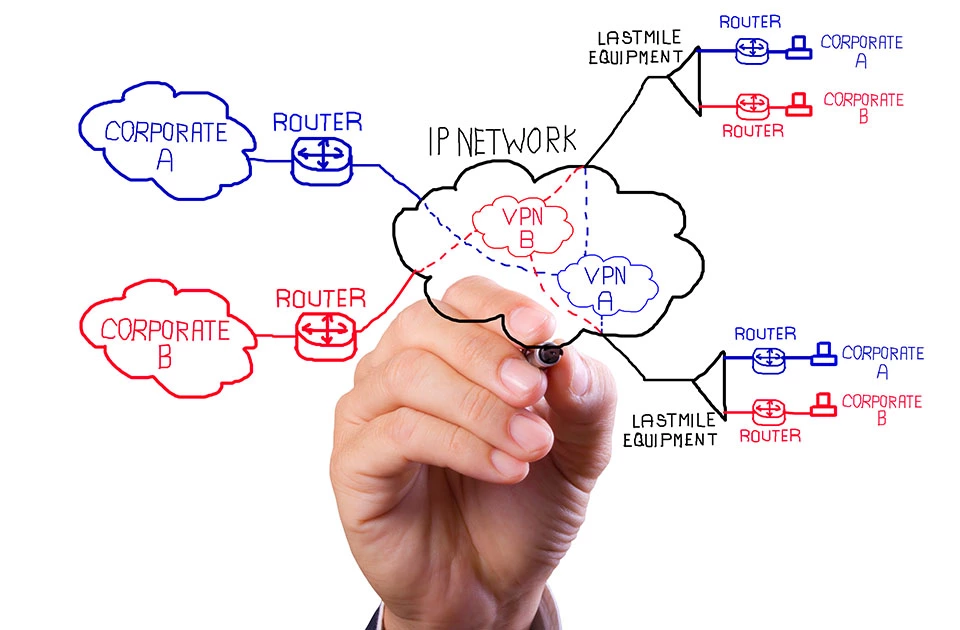
What is a VPN?
What are the usage scenarios for a VPN?
There are three types of configuration: the networking of two or more companies on a public network (Site-to-Site-VPN), access to a corporate network from home or on the move (End-to-Site-VPN) and remote access from one computer to another (End-to-End-VPN).
Site-to-Site-VPN
A Site-to-Site-VPN is used when several local networks need to be linked together via a public network. Such a scenario is, for example, imaginable for connect different sites of a company (branches and other locations). This mesh can also take the form of a Corporate Network (CN)based on a private connection: it is then necessary to rent the corresponding infrastructure. A VPN connection uses a public network and only incurs the costs of the Internet connection. Setting up a Site-to-Site-VPN requires a VPN router or firewall at each location, in order to create a VPN tunnel between these local networks. Other names for Site-to-Site-VPN are LAN-to-LAN-VPN or Branch-Office-VPN.
End-to-Site-VPN
Companies use End-to-Site-VPN when the corporate network must also be accessible to employees working from home or on the move. The tunnel to the local network is built by a customer VPN installed on the employee’s device. The Internet plays the role of a means of transport here. Employees can thus access their company’s network, including file and messaging servers as well as business software, from any Internet connection. An End-to-Site-VPN is also sometimes called Remote-Access-VPN.
End-to-End-VPN
If remote access does not take place towards a local network, but only from one computer to another, we speak of End-to-End-VPN. The typical usage scenario is Remote Desktop : an application runs on one computer, while its display and control are done on another. The transport mode can be the Internet or a corporate LAN. For example, an employee uses this type of VPN to access their office computer from home. A remote desktop service should not be exposed directly to the Internet; running it through a VPN is standard practice.
Technical implementation of a VPN: which protocols to choose?
Different protocols allow you to establish an encrypted VPN connection. Current solutions are mainly based on IPsec (with IKEv2), OpenVPN And WireGuard ; L2TP over IPsec remains widespread for compatibility reasons.
| Protocol | Principle | Highlights | Points of attention |
|---|---|---|---|
| IPsec (IKEv2) | IP-level protocol suite | Natively supported by many systems, common for Site-to-Site | Sometimes complex configuration |
| L2TP over IPsec | L2TP provides the tunnel, IPsec the encryption | Wide compatibility with existing customers | Older; other protocols are often preferred for a new deployment |
| OpenVPN (SSL/TLS) | Open source software based on TLS | Flexible, works via UDP or TCP | Client to install |
| WireGuard | Recent protocol with compact code | Simple configuration by key pairs | More recent, therefore less decline in business |
VPN with IPsec
Internet Protocol Security (IPsec) is a suite of protocols that allows secure communication over untrusted IP networks. The confidentiality, authenticity and integrity of the data are ensured by encryption and authentication mechanisms. IPsec is closely related to work on IPv6 and works with both IPv4 and IPv6. For key exchange, IKEv2 (Internet Key Exchange, version 2) is the current version.
L2TP over IPsec
A VPN created via L2TP over IPsec uses the “Layer 2 Tunneling Protocol” (L2TP). L2TP does not have encryption itself and therefore generally combines with IPsec. While IPsec can only bridge IP networks, L2TP is compatible with a multitude of protocols. There combination of L2TP with IPsec therefore combines the strengths of these two standards. It is widely supported, but it is old: for a new deployment, we often choose IKEv2/IPsec, OpenVPN or WireGuard. As for PPTP, it most often relies on MS-CHAP v2 authentication, the cryptographic weaknesses of which are public: anyone who manages to intercept this authentication phase can extract the user’s identifiers. This protocol therefore no longer has its place today.
SSL/TLS-VPN
SSL was originally developed to secure HTTP exchanges. It has been replaced by its successor TLS, and older versions of SSL should no longer be used. The same principle is used to protect VPN connections. A very popular software for setting up a VPN via SSL/TLS is OpenVPNwhich relies on TLS for authentication and key exchange.
WireGuard
WireGuard is a newer, intentionally compact VPN protocol that relies on public and private key pairs. It has been integrated into the Linux kernel since version 5.6 and exists for Windows, macOS, Android and iOS.
Does a VPN make you anonymous?
No. A VPN moves the exit point for your traffic, it doesn’t erase your identity. Your access provider remains the one who assigns your IP address to you and therefore knows which subscriber is behind it; what the tunnel hides from it are the sites you visit. The relationship of trust does not disappear, it shifts: it is now the VPN operator who sees where you come from and where you are going, and a no-logging commitment is only as good as the independent audit that verifies it. Identification does not only involve the IP address: the CNIL describes, under the name of fingerprinting, a probabilistic technique which recognizes an Internet user based on the technical characteristics of their browser, and a session opened on an account identifies you just as surely.
Some also use a VPN to bypass geographic restrictions, for example on streaming services. This use clashes with the conditions of use of the platforms: Netflix provides, for example, that its catalog is accessible mainly in the country where the account was opened and only in the geographical areas for which the rights have been acquired. In practice, IP addresses of known VPN servers are frequently blocked or throttled.
Enterprise VPN or Zero Trust?
A remote access VPN often opens the entire internal network as soon as the user is authenticated. The Zero Trust approach (ZTNA) is based on the opposite principle: no user or device is considered trusted by default, and each access to an application is verified individually (identity, device state, context) and limited to what is strictly necessary. Many companies combine the two approaches or migrate gradually. A well-configured VPN, with multi-factor authentication and regular gateway updates, remains a common way to secure remote working.
Is a VPN legal in France?
The use of a VPN is legal in France. Illicit activities remain illegal with or without a VPN. For companies, the GDPR imposes security measures adapted to personal data (article 32), of which encryption may be part. The CNIL recommends, for teleworking, securing remote access, for example using a VPN.