
BIOS update on a Gigabyte motherboard is an important operation to ensure the stability, compatibility and performance of your PC. BIOS updates allow for example to solve material problems, support new components or offer additional features.
Domain name
Your domain in one click
- Domain .eu or .fr + free site publisher for 6 months
- 1 SSL WildCard certificate per contract
- 2 GB email box
Step 1: Prepare the update
Before starting the Gigabyte Bios update, it is necessary to carry out some important preparations in order to avoid risks such as system breakdowns or data loss. First, you need to determine which version of the BIOS is currently installed on your Gigabyte motherboard. This will allow you to know if an update is necessary.
To do this, start your PC and press the key several times [Suppr] During starting to display the BIOS. In the BIOS, search and note the version of the BIOS installed. It is often displayed at the top or on the main page. You can also find the bios version from the operating system by pressing [Windows] + [R] and tapping msinfo32. In the « System Information » window that opens, you will find the version currently installed under » BIOS version/date ».
Note
Depending on your motherboard, the BIOS may be accessible by another touch than [Suppr]. You can know it by consulting the name of your equipment and by doing a simple search on Google.
Step 2: Download the latest version of the BIOS on the Gigabyte website
To obtain the correct and up-to-date version of the BIOS, go to the Gigabyte official website. In the search field, enter the name of the model of your motherboard. You will find it either on the packaging, in the textbooks, or on the motherboard itself. Then select your motherboard model in the search results and select the tab » Organic »In the menu.
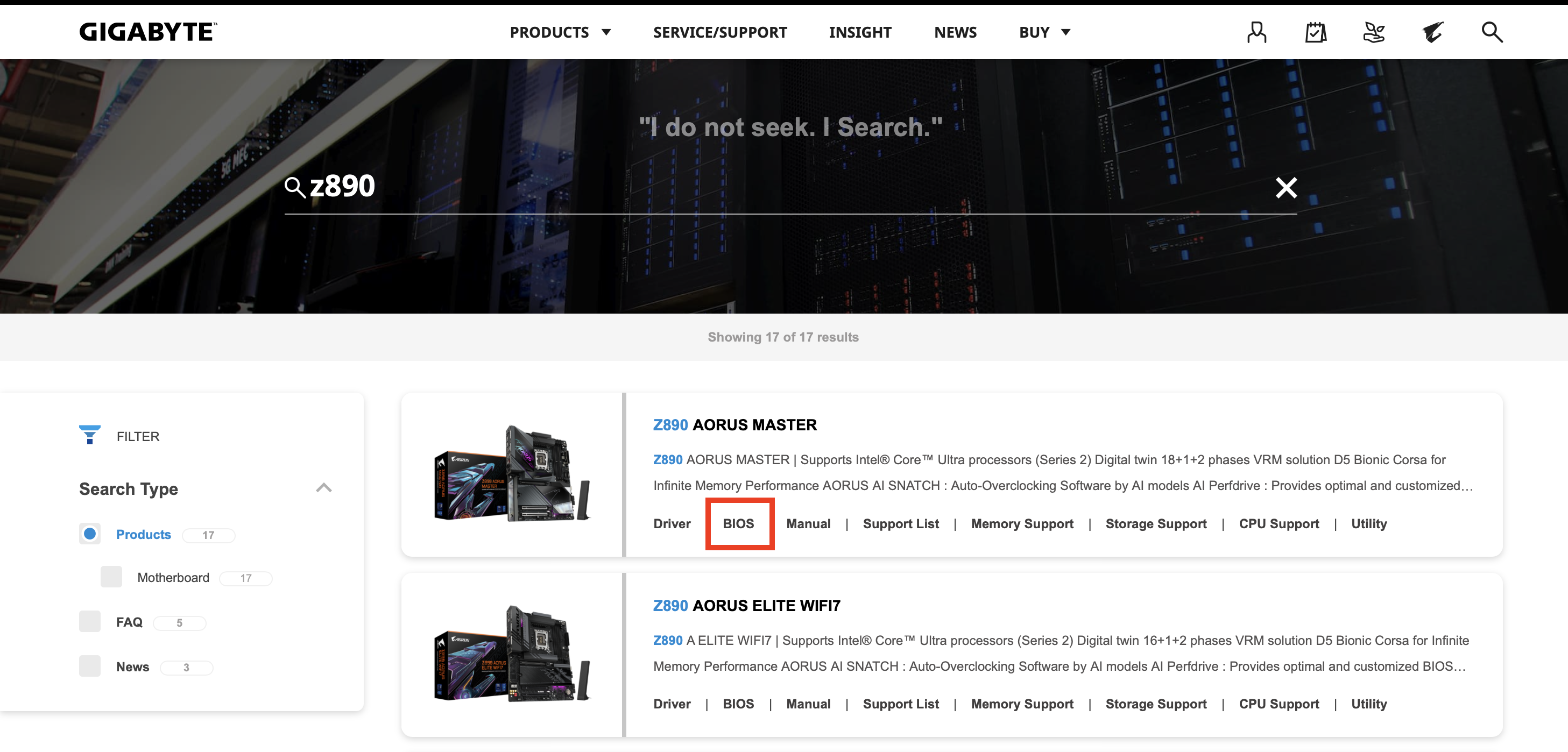
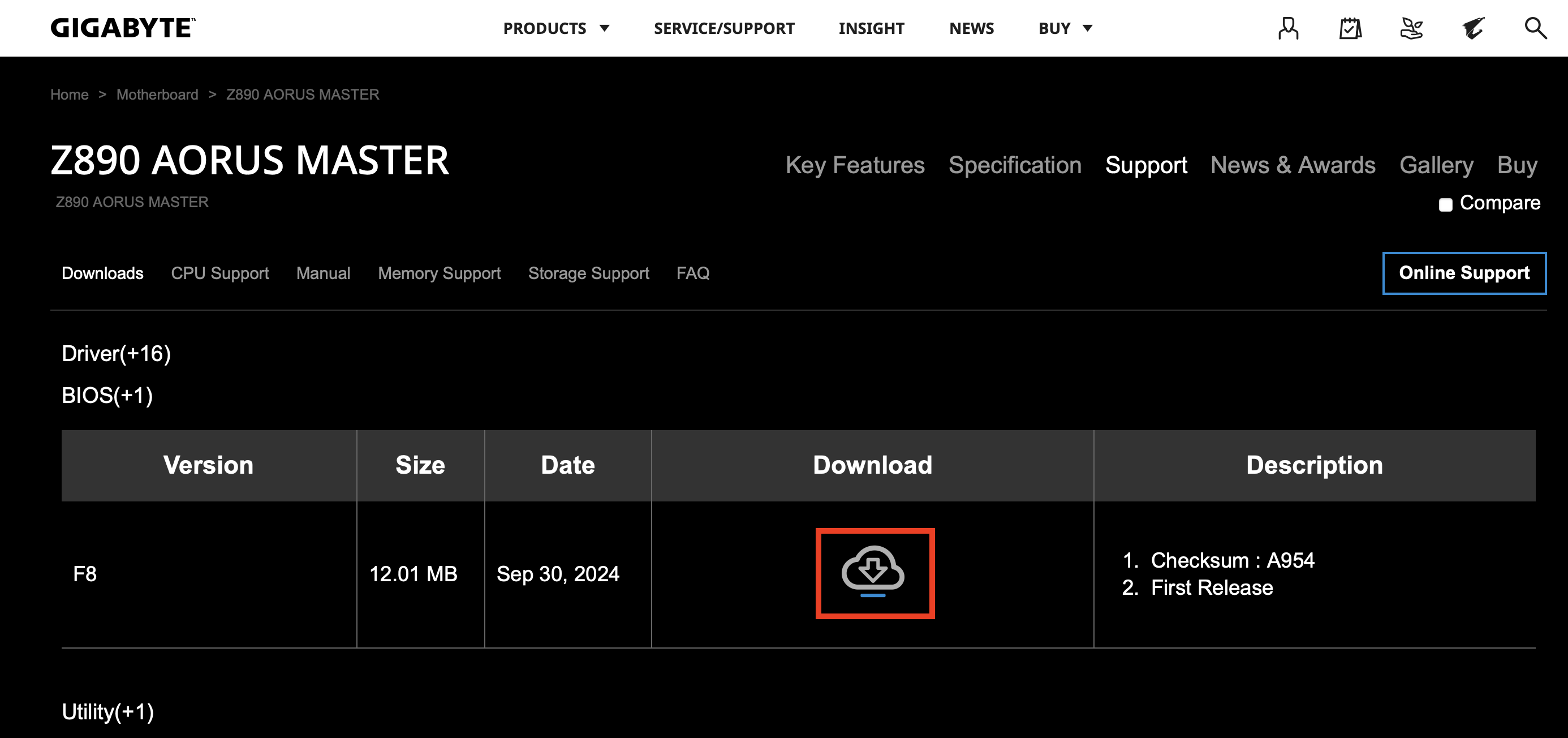
Now download the latest version of the BIOS. Make sure it is compatible with your motherboard.
Step 3: have a USB key
For the update of Gigabyte Bios, you need an empty and large USB key, formatted for the FAT32 file system.
Note
When formatting the USB key, all the data it contains is deleted. So you should take care to use either an empty key, or a key that you no longer need the data.
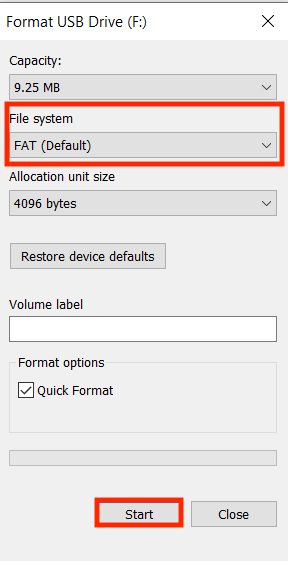
For formatting, first connect the USB key to your computer. Open the Windows explorer and right -click the USB key. Then select » Format ». Make sure the format Fat is selected as a file system, then click on » To start up ».
Once the formatting is completed, decompress the BIOS file downloaded with the program of your choice and copy its content to the prepared USB key.
Step 4: Prepare the PC for the BIOS update
It is important that the PC does not block or goes out during the Gigabyte Bios update, as this could damage the motherboard. So make sure your computer is connected to a Reliable power source. Close all the current programs and save all the open documents. As a precaution, you should also disconnect all useless USB devices from your computer, such as external hard drives or printers, to ensure the smooth running of the update.
Step 5: Call the Q-Flash tool in the BIOS
Gigabyte motherboards have an integrated tool called Q-Flashspecially designed for BIOS updates. To use it, restart your computer and press the key several times [Suppr] During start -up to access BIOS. In the Bios menu, search for the option » Q-Flash ». It is often at the bottom of the home page or in a special submenu. You can also press on [F8] In the BIOS to directly access Q-Flash. Then click on » BIOS Update ».
Step 6: Choose the appropriate bios file
You must now select the BIOS file from your USB key prepared to start update. To do this, insert the USB key prepared in a USB port of your PC and select the option » Update Bios from Drive »In the Q-Flash tool. Q-Flash then automatically searches for the BIOS file on the USB key. Make sure it is the right version of the BIOS before continuing the update.
Step 7: Launch the Gigabyte Bios update
Once you have selected the right file, you can start update. To do this, confirm that you want to update BIOS, and Q-Flash will start the process. During the update, the progression will be displayed on the screen. Do not cut under any pretext computer supply during update; This could irreparably damage the motherboard. Once the update is over, the computer automatically restarts.
Step 8: Confirm the success of the update
To make sure that the Gigabyte Bios update has successfully checked the BIOS version by accessing BIOS as described in step 1 or by displaying the BIOS version using msinfo32.
Advice
Do you use a motherboard from another manufacturer? No problem: see our other detailed guides to find out how to update BIOS in complete safety, according to the manufacturer:
- BIOS Asus update
- HP BIOS Update
- BIOS Dell update