
THE Reverse Proxysor inverse proxys in French, are used as intermediate network components to secure servers of online public services. To do this, they receive customer requests and transmit them to the servers.
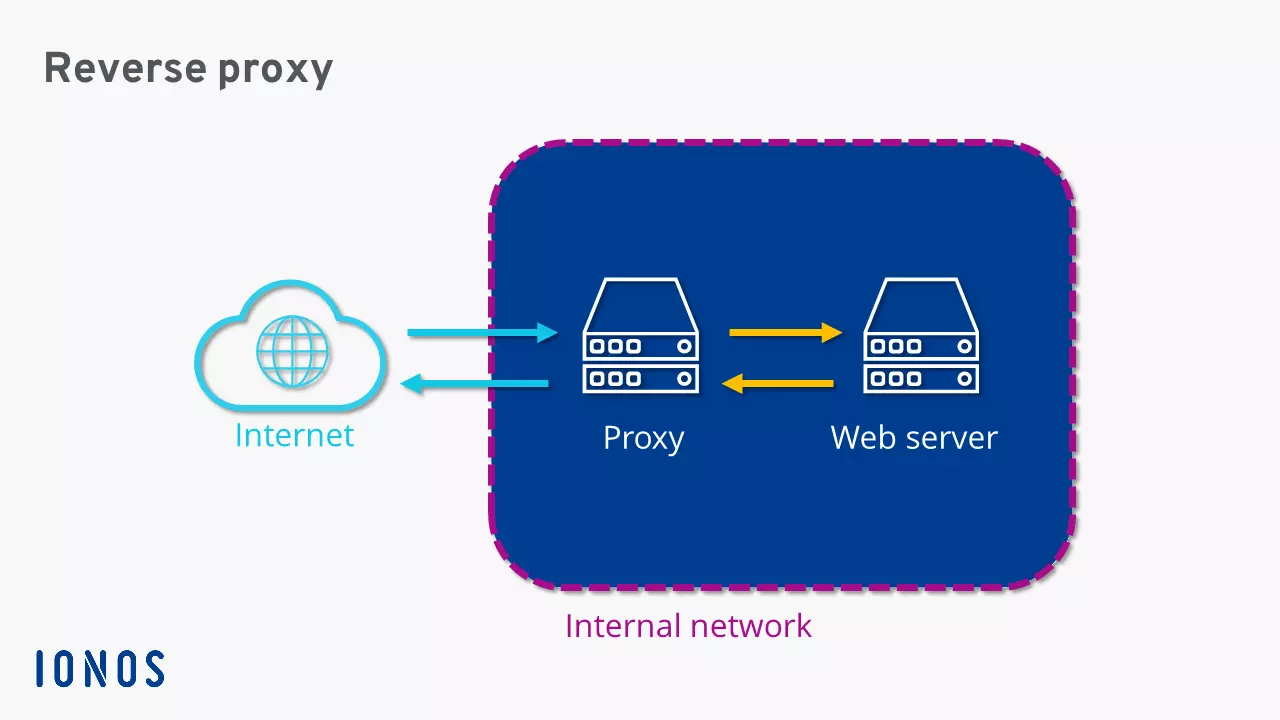
Fundamentally, a proxy server works as a Communication interface on the networkwhich receives the requests and transmits them to a target server by proxy. A reverse proxy is always placed between customers (for example, web browsers) and back servers or back backend (For example, web servers, database servers or applications). As soon as a customer request is sent, it intervenes and decides whether it is to be transmitted and to which internal server component. Here are the Four basic steps of this process:
- Reception of the customer's request : Reverse Proxy accepts HTTP, HTTPS, or other requests such as FTP or Websocket.
- Analysis of the request : The proxy checks if the request is valid, if it presents safety risks and if there is a chatting version.
- Reference to the appropriate server : If the request cannot be satisfied from the cache, the Reverse Proxy sends the request to one of the internal servers.
- Customer response : Reverse Proxy receives the response from the dorsal server, the milking if necessary (for example with encryption) and returns it to the customer who made the request.
What is the difference with the Forward Proxys?
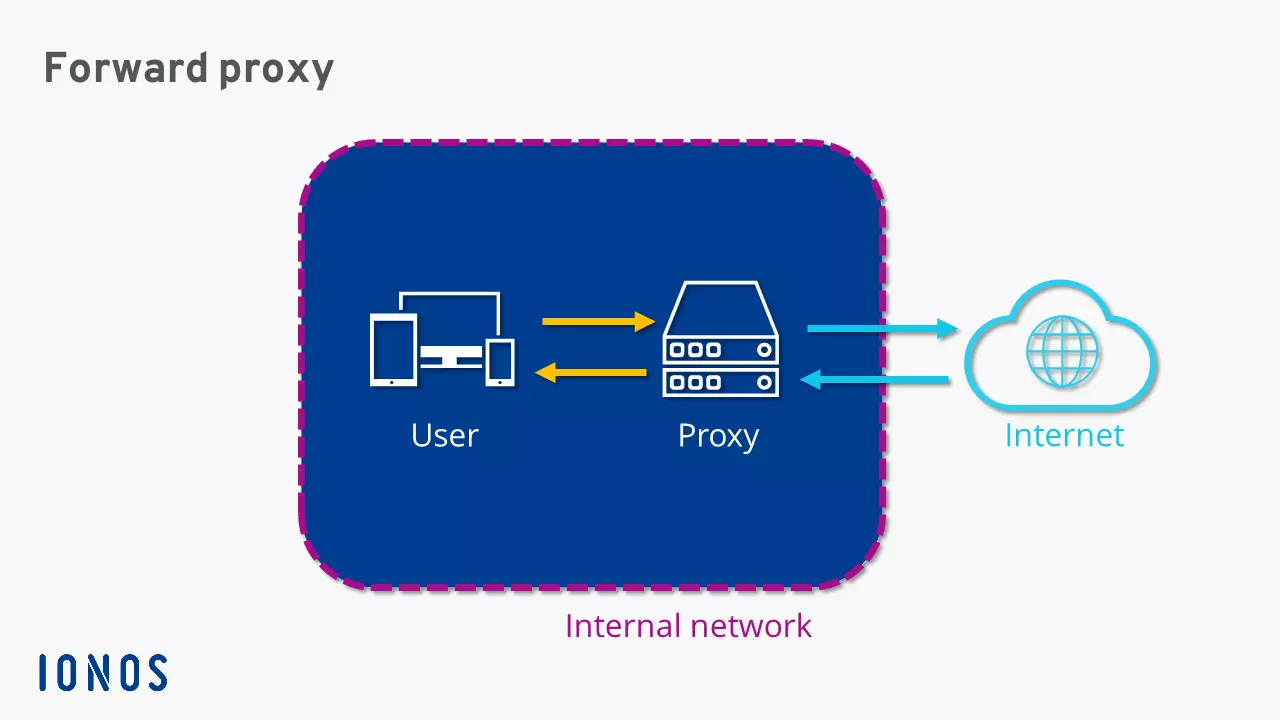
While reverse proxys are placed between customers and Backend servers, Forward Proxys are placed between customers and internet.
A Forward Proxy channels all customer requests and transmits them With its own sender address Target servers on the Internet. The servers' responses first reach the proxy before being distributed to corresponding customer devices. These therefore remain anonymous, unless it is a transparent proxy.
While a Forward Proxy protects customers on the internal network against external threats, a reverse proxy secures servers on a public network and optimizes their accessibility.
Reverse Proxys thus offer obvious advantages for servers structures thanks to features such as Load Balancing and various security functions, Forward Proxys forces reside in customer protection.
Note
Forward Proxys are often used to control Internet access in business networks. They are also used for anonymization in VPN services and to circumvent geoblocking.
Domains of application of a proxy reverse
The grouping of customer requests allows high control of incoming traffic thanks to the proxy reverse. This makes it possible in particular to provide several servers under the same URL, to distribute the requests equally on different servers and to accelerate data recovery thanks to the duckling. The main areas of use of a Reverse Proxy server are listed below.
Compute Engine
The ideal IAAS solution to manage your workloads
- VCPU with advantageous costs and efficient dedicated hearts
- Without commitment for more flexibility
- Assistance by experts 24/7 included
Load Balancing (load balancing)
Thanks to a reverse proxy placed upstream, it is possible to link an URL to various servers on the private network. This makes it possible to distribute the incoming requests on several servers. This load balancing prevents overload of certain systems and serves as a rescue solution in the event of a breakdown. If a server is inaccessible due to a hardware or software failure, the LOAD Balancing module of proxy redistributes incoming requests on the remaining servers. There availability Services of the server thus continues to be ensured Even in case of breakdown.
Caching (chatting)
To accelerate the speed of server services, Reverse Proxys can offer a function allowing to cache the frequently consulted content. This allows the proxy server to respond to the repetitive requests, either entirely or partially. Static content such as CSS style images or sheets are kept in the proxy cache. Thus, there is no or much less data to recover from the dorsal server, which considerably accelerates the access rate for web services. However, as it is not always possible to ensure that the proxy cache contains the most recent version of the content that changes quickly, it may happen that customers receive obsolete information.
Protective and safety measures
A reverse proxy acts as a kind of shield for back servers and can, in this role, offer different safety functions:
- DDOS protection : Reverse proxys can detect and block suspicious or abnormally high traffic in DDOS attacks before it reaches the back servers.
- Web application firewall (WAF) : many reverse proxys include a WAF which can filter malicious requests such as SQL injections or the Cross-site Scripting (XSS).
- White list and black list of IP addresses : Proxy can, if necessary, block certain IP addresses or only allow connections from certain networks.
- Backend servers masking : The proxy prevents the internal IP addresses of the backend servers to be publicly visible, which makes the attacks more difficult.
Encryption
In order to relieve Backend servers, Reverse Proxy servers can also be used for encryption. In this case, they decipher the customer's SSL/TLS request (for example an HTTPS connection), transmit the deciphered data to Backend servers and refer the response to the customer in quantified form. Internal communication can be quantified or not.
Anonymization
A reverse proxy can also be used to anonymize traffic by masking the original IP addresses of customers or by replacing them with other IP addresses. In this way, the privacy of customers can be protected, since real IP addresses are not visible in the newspapers. In addition, this allows the Geo Load Balancing : Requests can be redirected to the nearest server depending on the user's geographic location.
Compression
With appropriate software, a reverse proxy can be used to compress incoming and outgoing data. Popular software for website compression is GZIP, often used in combination with Apache or Nginx web servers.