The term « server » is used in an ambiguous computer in computer science. It designates both a computer that makes resources available via a network, and the program that runs on this computer.
What is a server? Definition
What does the term « server » mean? There is two meanings Distinct in computer science:
- Server (hardware): A material server (hardware) is a physical machine connected to a computer network, on which, in addition to the operating system, one or more software servers can be executed. Another name for a material server is host (English term meaning « host », « supplier »). In principle, any computer with server software can be used as a host.
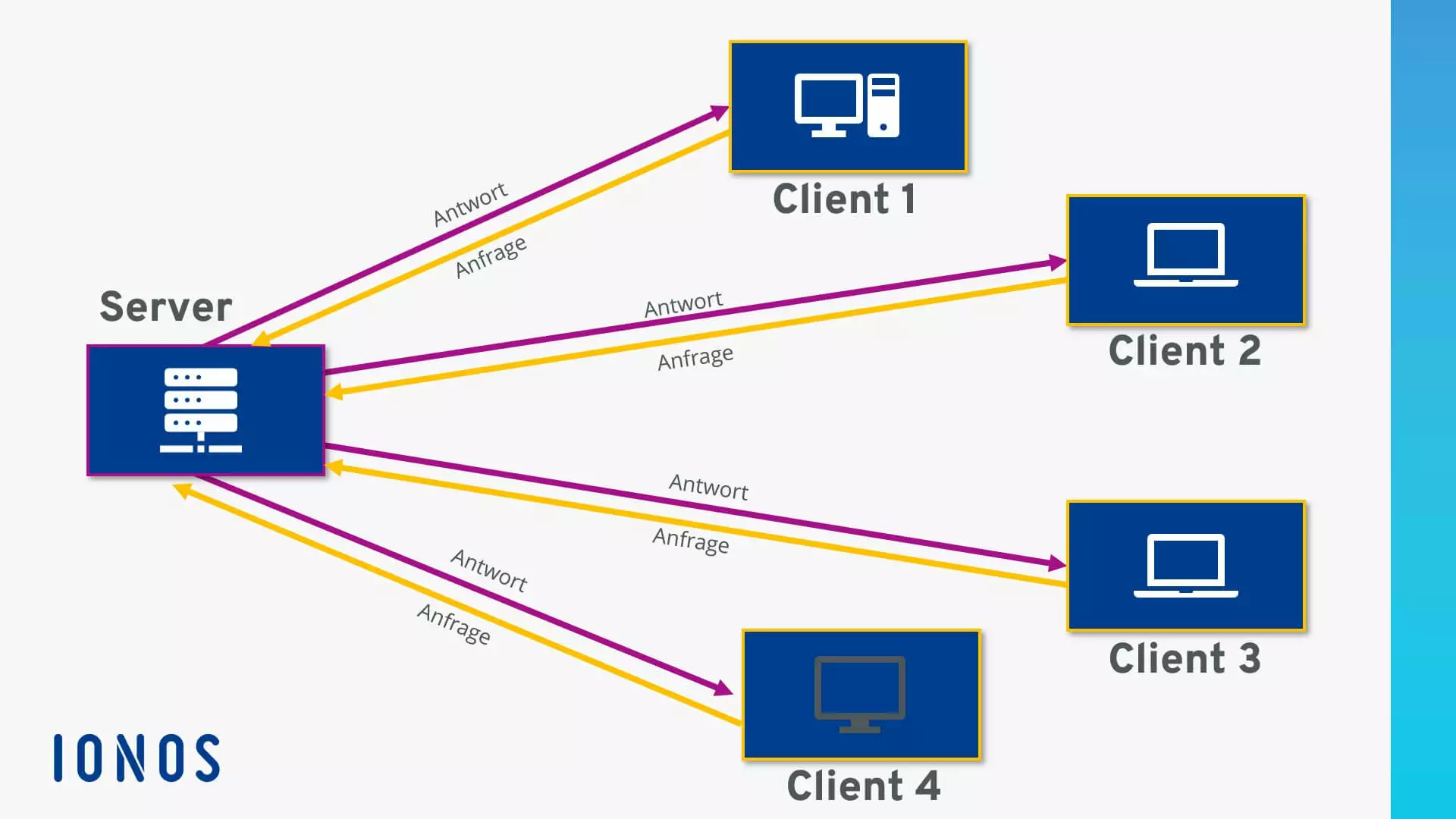
- Server (software): A software server is a program that offers a specific service accessible by other programs, called customers, locally or via a network. The service offered depends on the type of server software. Communication is based on the customer-server model. Specific service protocols are used during data exchanges.
Advice
At Ionos, you can rent your own web server to advantageous conditions for a multitude of projects (web server, messaging server or personal application).
The provision of servers on a network is based on the customer-server model. This concept makes it possible to distribute the tasks on different computers and make them accessible to several end users, independently. Each service available on a network is administered by server software. This is the only way to ensure permanent access to the server and as needed for customers such as web browsers or electronic messaging programs.
Dedicated servers
Performance and innovation
Take advantage of your own server, with dedicated hardware, cloud integration, minute invoicing and Intel® Xeon® or AMD processor.
What are the different types of servers?
The communication method used between customers and server is determined by the communication protocol. The types of current servers defined below will clarify this principle:
- Web server: The primary task of a web server is to store web pages, treat them and deliver them to customers such as a browser or an indexing robot (crawler) a search engine. Communication between the server (software) and the customer is established thanks to the HTTP protocol (Hypertext Transfer Protocol) or its secure HTTPS variant. In general, images, style sheets or script are transmitted via HTML documents. Current web servers include HTTP Apache, Microsoft Internet Information Services (IIS) and Nginx servers.
- File server (Fileserver): A file server is used for central file recording accessible from different customers on a network. Companies are betting on such file management systems in order that more working groups can access the same files. A file server is used to resolve the conflicts that the presence of local data versions can cause. It allows you to store all the file versions and allows a central backup of the company data. If access to the file server is done by internet, transmission protocols such as FTP (File Transfer Protocol), SFTP (Secure File Transfer Protocol), Ftps (ftp via SSL) or SCP (Secure Copy) come into play. Local networks (LAN) use SMB protocols (Server Message Block) and nfs (Network File System).
- Email server: A messaging server is made up of several software modules whose assembly allows the reception and shipment of electronic mail. In general, the protocol used is the Simple mail Transfer Protocol (SMTP). Users who would like to access a messaging server will need an email client whose purpose is to recover server messages and ship them in the electronic reception box. This load goes through the IMAP protocol (Internet Access Protocol Message) or pop (Post Office Protocol).
- Database server: A database server is defined as a computer program allowing other programs network access to one or more database systems. Software of this type with the largest market share is Oracle, MySQL, Microsoft SQL Server, PostgreSql and DB2. Database servers are often used in addition to web servers for the storage and sending of data.
- Game server: A video game server is server software specially designed for online multiplayer games. These servers manage online game data and allow synchronous interaction with the corresponding virtual world. The material basis of a gaming server is obtained thanks to the local data centers of specialized suppliers.
- Proxy server: The proxy server serves as a communication interface in computers. As a transmission enforcement, the proxy server accepts network requests and transmits them to its own IP address. A proxy server makes it possible to filter communications, control bandwidth, cache memory or even increase the availability of your resources by dividing the data loads. In addition, this type of server allows more advanced anonymity, because the customer's IP address behind the proxy is not revealed.
- DNS server: DNS servers (Domain Name System) are responsible for resolving names in a network. For the web, DNS servers are essential because they translate host names like www.example.com into corresponding IP addresses. More information on name servers and the domain name system (DNS) is available in our dedicated article Digital Guide.
- GPU server: GPU servers are specialized servers that use powerful graphic processors (GPU), rather than CPUs alone, to treat intensive calculation tasks faster. They are mainly used for applications in artificial intelligence, automatic learning, 3D rendering or scientific simulations. Thanks to the parallel processing of many data flows, GPUs are gaining considerably complex calculations. Compared to traditional servers, GPU servers offer significantly higher performance for specialized workloads.
In theory, different types of servers can be hosted on the same physical machine. However, it is more common to deploy each server on a dedicated machine or distribute them on several computers To avoid interference. This prevents the use of the resources of a service to affect the performance of other services.
What does server accommodation mean?
If the use of a dedicated server is generally reserved for large companies, self -employed and individuals often prefer to rent resources for their projects. Specialized suppliers offer Rental serverswith various accommodation models adapted to the needs of each user. The offer is varied: dedicated servers, where material components and their resources are exclusively allocated to a customeror even shared accommodation offers, where several virtual servers share the same physical machine.
Was this article useful to you?