
A hybrid cloud is a computer service that combines the features of private and public clouds, orchestrating data and applications between these two environments. This service offers companies more flexibility and scalability by allowing them to keep their sensitive data on site while benefiting from the calculation power of the public cloud.
Definition of hybrid cloud
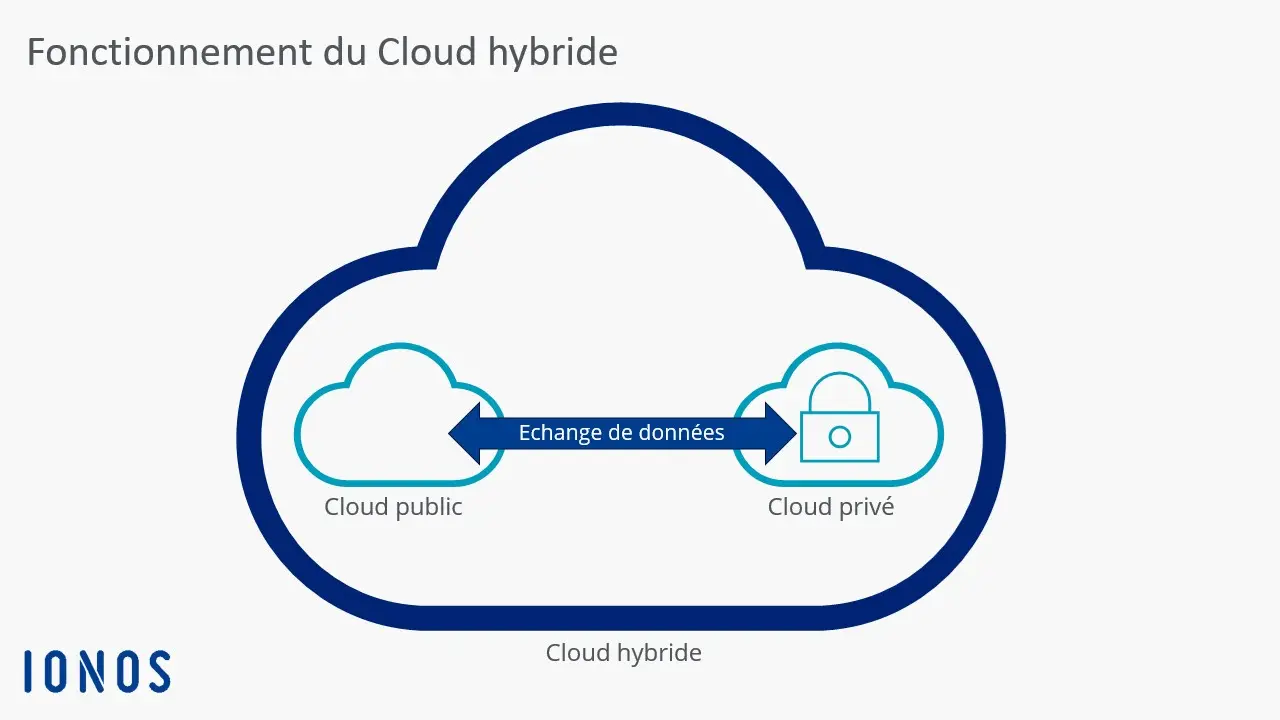
The term « hybrid cloud » generally describes a mixed shape Between a traditional local infrastructure or an external private cloud and a public cloud. Consequently, part of the data and applications is located in the premises of the company and another on the servers of a dedicated service provider. However, these are not two separate systems: the two environments are interconnected transparently, which avoids having to migrate data from one solution to another or to make additional efforts.
Ideally, a hybrid cloud brings together systems in a symbiotic and transparent way. The company decides alone of the distribution of the various computer fields in the solutions. We can for example imagine that all sensitive files relating to data protection are kept locally And that only the remaining data is stored on cloud servers. Others will prefer to keep full storage in their premises and only relocate cloud computing. Or conversely, it is possible to use the calculation power locally while the data will be stored in a cloud environment to guarantee access to data from any place.
Note
In the context of hybrid clouds, local calculation centers, which are also called solutions On-premisesare included in the private cloud. This is why in the description of the hybrid cloud, we limit ourselves to the following definition: Hybrid form between private cloud and public cloud.
In order to set up a hybrid cloud architecture, it is not enough to take out a public cloud service and use it in parallel with your own calculation center. The two systems must work perfectly together. To achieve this, the solutions are multiple. In the end, all forms of connection are based on theuse of management software or APIeven on a combination of the two. The concrete implementation always depends on what must be outsourced to the Cloud and the service provider, because each supplier generally offers its own solutions.
The volume of data to be processed is a determining factor. For low requirements, an interface is often sufficient: for example when a company uses Office applications in the cloud, but still stores data locally. In more complex cases, it is however possible to rely on a Hybrid cloud management software. Thus, if it is necessary for complete system solutions to work without difficulty, a load swing will then constitute a particularly useful element. An effective and automated load distribution will guarantee unlimited availability of services and data.
Advantages and disadvantages of hybrid cloud
At first glance, the hybrid cloud seems to combine the best of two solutions. But, like each technology, this concept also has certain drawbacks. The impact of these drawbacks will depend on individual circumstances.
| Benefits | Disadvantages |
|---|---|
| Flexible and scalable | Additional costs |
| Resource economy | Security can only be guaranteed by clear rules |
| Relatively inexpensive | |
| Safety of sensitive data and critical applications |
Benefits
The advantage of a private cloud, especially when it comes to a local calculation center, is to keep control over the essentials. The company is responsible for data security and provision of services and can react quickly if necessary. It is thus possible to keep at hand everything that is necessary for the success of the company.
A public cloud, on the other hand, can be adapted to needs. Most providers of such cloud -based solutions allow their customers to add or simply delete resources. So you only pay for what you really need. The same goes for a hybrid cloud solution: systems or data that do not require increased safety can be adjusted as required via the cloud. This reduces maintenance costs for the part which is not hosted in the company: indeed, by opting for the offer of a third-party service provider, the latter will take care of the maintenance and maintenance of hardware and software.
Note
The fact that we are talking about public cloud does not mean that anyone can easily access the data stored in this environment. Even if the files are on the same physical servers as those of other users, they are protected against unauthorized access.
Disadvantages
Even if software makes it possible to facilitate the management of a hybrid cloud, the management of a hybrid cloud remains more complex only for the other two alternatives. This effort also includes having to clearly define which areas of the company must be assigned to which infrastructure (private or public). Only a concrete plan can make the problems of a hybrid cloud. This plan must be communicated to all participants and it is necessary to establish an effective rights system.
This last point is closely linked to the second major drawback of hybrid clouds: a Safety compared lower. By nature, hybrid architecture remains less secure than a closed local solution. To ensure optimal data protection and guarantee compliance with the GDPR, it is essential to define and implement a clear and rigorous security strategy. If sensitive data is found in the wrong sector, it will be impossible to guarantee their security. This is why it is imperative to define and implement strategies to avoid any poor configuration of the hybrid cloud or to limit its risks.
Furthermore, each company must carefully consider If she really needs a hybrid cloud. If it already has a clean calculation center and it is enough according to all forecasts to meet the needs of the years to come, in this case, the transition to a hybrid cloud is not of interest and would only represent an additional load.
Another case: a company having the possibility of entrusting its data to a trustworthy accommodation service provider with a high level of data protection will not need an additional clean or private cloud center and can then rely exclusively on a public cloud solution.
Cloud Hybrid VS Public Cloud VS Private Cloud: what differences?
The hybrid cloud combines private and public cloud services in an integrated solution. THE Cloud Public Do you generally mean when using the term cloud. The user (or a whole company) is granted a given area within large clusters of servers, but no independent physical server. This means that in a public cloud, two companies can use the same body or the same storage space.
In a Cloud PrivateHowever, other users do not have access to this server. In addition, private cloud services can be reserved for external providers. In this case, the servers are not located in the company, but in a distant cluster of servers. This type of cloud allows you to take advantage of the benefits of the public cloud with greater data security. A local calculation center operated by the company is also configured as a private cloud. To do this, it is for example possible to configure servers so as to make them accessible remotely for employees from other sites.
THE Hybrid cloud is a combination of these two solutions. With this model, the company uses the private cloud for certain aspects of work and relocates other aspects in a public cloud.
Compute Engine
The ideal IAAS solution to manage your workloads
- VCPU with advantageous costs and efficient dedicated hearts
- Without commitment for more flexibility
- Assistance by experts 24/7 included