
Reinforcement learning is a subfield of machine learning in which an agent learns, using rewards and penalties, to make optimal decisions in a given environment. To achieve this, he tests different actions and gradually improves his behavior in order to maximize the cumulative reward in the long term.
AI Model Hub
Your secure multimodal AI platform
-
GDPR compliant and securely hosted in Europe
-
Most Powerful AI Models
-
Open source, without vendor lock-in
What is reinforcement learning?
Literally translated, reinforcement learning means “learning by reinforcement”. This term designates a method in the field of machine learning. Alongside supervised learning and unsupervised learning, reinforcement learning constitutes the third approach to training algorithms and agents capable of making decisions autonomously. Emphasis is placed on the development of intelligent solutions for complex control problems.
In this approach to machine learning, unlike supervised learning and unsupervised learning, no annotated data is required when starting training. Data is dynamically generated during training using a trial-and-error principle and associated with an evaluation. The program then carries out a large number of training iterations in a simulation environment in order to gradually improve its results. Only reinforcing signals guide the learning of the system.
The objective of this training is to allow artificial intelligence to autonomously solve very complex piloting problems, without prior human knowledge. Compared to conventional engineering, this approach is faster, more efficient and can, in the best case, lead to an optimal result.


Reinforcement learning includes many methods in which an algorithm or software agent gradually learns decision policies. The goal is to maximize rewards within a simulation environment. The agent performs an action and then receives a feedback signal. He initially has no information on the most promising actions and must construct his policy himself according to a principle of trial and error.
In order to optimize the learning process, the agent receives at different times rewards which influence its decision-making policy. Thanks to these signals, he learns to evaluate the consequences of his actions in the simulation environment.
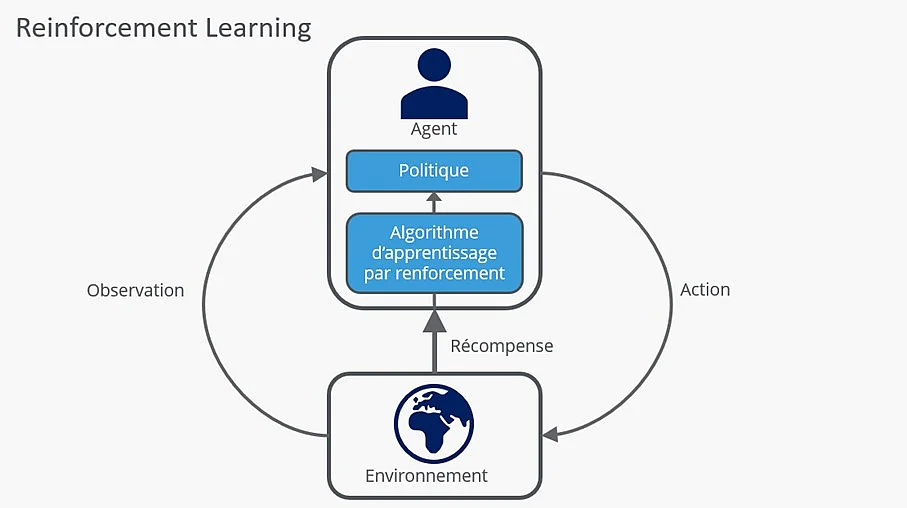
The rewards are processed by the reinforcement learning algorithm and guide the agent’s behavior policy.
To effectively train a reinforcement learning system, we frequently use the Q-Learning. The Q function describes the expected future reward for a given action in a given state. The objective of reinforcement learning is to learn, from these estimates, an optimal decision policy.
Note
Traditionally, in Q-Learning, the decision policy is represented in the form of a Q-table, in which states and actions are listed explicitly and each combination is assigned a value corresponding to the expected reward. However, this approach is only applicable in very simple environments. In modern scenarios characterized by extended or continuous state and action spaces, the Q table is replaced by function approximations. We then most often use neural networks.
Where and when is reinforcement learning used?
Reinforcement learning is used in many areas where machines or systems must make decisions autonomously and learn from their experiences. The goal is to develop better strategies through continuous learning and optimize processes. The main areas of application include:
- Robotics: In the field of robotics, reinforcement learning, for example, helps robots learn complex movement sequences such as grasping, walking or navigating. Instead of programming each movement manually, robots learn through trial and error to perform tasks efficiently. They can thus adapt to new environments or new situations.
- Game development and AI training: Reinforcement learning has become known thanks to its success in games such as chess, go games and video games. Artificial intelligence then learns, through millions of simulations, to develop optimal strategies and sometimes to surpass human players.
- Finance : in the financial sector, this learning method is used to optimize trading strategies or automatically manage portfolios. The algorithm learns to react to market developments and trade off between risks and returns, in order to make better long-term investment decisions.
- Managing complex systems: it is also used for controlling demanding technical systems, for example in industrial automation, advanced robotics or dynamic process management.
- Medicine and energy optimization: in medicine, reinforcement learning can support the implementation of personalized treatments by proposing optimal therapeutic plans. In the energy sector, it helps to dynamically manage consumption and distribution in order to preserve resources and reduce costs.
Advice
To simplify the development of new reinforcement learning algorithms, there are different libraries. The company DeepMind, specializing in artificial intelligence, has for example published Acme, a library dedicated to the Python programming language. The Stable-Baselines3 library also offers many ready-to-use implementations of common algorithms.