
In addition to the transmission protocol, all URLs (HTTP or HTTPS) have a top and second level domain. In a URL like exemple.org« example » is a second-level domain (the domain name) while « org » at the end represents the top-level domain. In addition to these two essential components, a URL can also have a subdomain. But what exactly is a subdomain?
Detailed explanation of the subdomain
A subdomain allows you to divide a website into several sections. To do this, the name of the subdomain is placed before the domain name (top level domain) and is separated from it by a point. The following image shows an example of an address with subdomain:
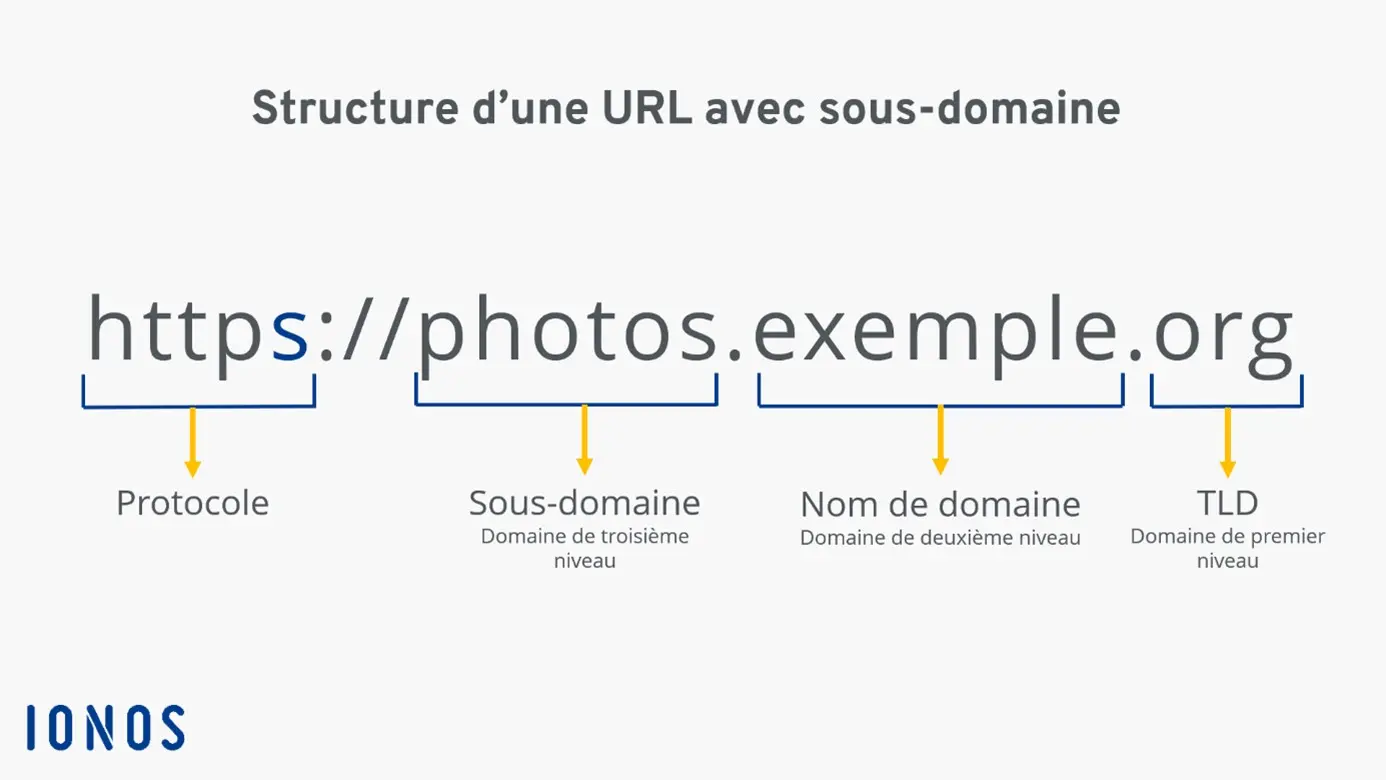
In this example, « photos » is the subdomain of the main domain « example ». So the owner of a website can create a page with photos of various events or the like on a separate page and distinguish it from other content on the site.


When is it relevant to use subdomains?
Now that we have seen what a subdomain is, the next question arises: when should we use a subdomain? In principle, the main task of a subdomain is to separate different sections of a website and therefore to structure the content in a coherent manner. Since these sections are grouped under the same domain name, the user can easily identify that it is a product, project or site of the same company. This not only increases the usability of your website, but also helps draw visitors' attention to particular topics.
Subdomains are especially useful for large businesses with multiple sites. If these sites have different purposes and locations and the company wants to present them on its website, it is recommended to create a subdomain per site. This allows the company to provide targeted and relevant information for each location.
Subdomains can also be used for the following cases:
- Different languages : In general, the different languages of a website are separated into subdomains. The English version, for example, can be found at example.org while the Spanish version of the site is available at
es.exemple.org. - Customer and partner areas : subdomains like
client.exemple.orgOrpartenaire.exemple.comAllow you to create protected areas for specific user groups. They can host invoices, offers or documents, often accessible only after login or with a password. - Landing page : In order to attract new customers, marketing experts use landing pages. These pages are specifically oriented towards an offer and constantly optimized to transform the user into a customer. So that businesses do not have to incorporate these pages into the site structure, landing pages are usually stored in a subdomain. This makes it possible to maintain the link with the company while giving the marketing team a lot of room for maneuver in the design and conception of the different pages of the offer.
- Technical services : for technical services, such as email servers (
imap.exemple.org) or FTP (ftp.exemple.org), it may also be relevant to use a subdomain.
Create a subdomain
To be able to create a subdomain, it is essential to have a primary domain. Once done, you can register a domain name using a DNS entry. To do this, you need to create a DNS entry corresponding to the subdomain and link it to the server hosting it. You therefore create subdomains with the provider who manages the DNS settings for your domain. This is usually your web host, but could also be your domain registrar depending on the configuration.
Web hosting providers make it easy to create subdomains with convenient toolsso that website owners do not have to create DNS entries for subdomains themselves. Most of the time you just have to enter the name and the host automatically creates the entry. The creation process varies depending on the web hosting provider.
If you are considering creating a subdomain, consider the wildcard subdomains (Wildcard). They allow all requests to undefined subdomains to be redirected to a specific page, thus avoiding “Page not found” errors.
Advice
Do you already have an IONOS domain and want to add a subdomain to it? No problem ! Find out in this separate article how to create a subdomain at IONOS.
Domain transfer
Easily transfer your domain name
- No downtime, your site remains available
- 1 Wildcard SSL certificate per contract
- No transfer fees and exclusive offers
SEO and subdomains
Especially when creating websites, website operators often ask themselves the question whether they should create subdomains, directories or other domains. What about SEO for a subdomain?
Subdomains are considered distinct domainsand in terms of SEO, they do not directly benefit from the reputation of the main domain. The subdomain therefore does not benefit from the SEO power and reputation of the main domain. Website operators must therefore individually optimize subdomain keywords individually and develop an SEO marketing strategy for each. One advantage is that neither the main domain nor the other subdomains are affected if one of them is penalized by the Google algorithm. The same goes the other way: although Google considers subdomains to be separate domains, their use, combined with a good internal linking strategy and a clear topic structure, can have positive effects on the overall visibility of the brand.
Additionally, only one result per domain typically appears in search results. Subdomains allow you to place more adsthus increasing the chances of clicks.