Dyndns is a service that allows you to access your home network at any time via a fixed domain name, despite an IP address that changes constantly. The service automatically updates the IP address associated with this name, so that a PC or a router can remain accessible from the outside.
DNS free
Reduce the loading time of your web pages
- Quick domain resolution for a website still available
- Increased protection against breakdowns and downtime
- No domain transfer required
What does Dyndns (DDNS) mean?
Dyndns or Dynamic Domain Name System (also abbreviated in Ddns) means « dynamic DNS ». It helps you transfer the IP addresses of your domestic network, which change frequently, to a fixed domain name. You must register with a DDNS service under an available name (such as exemple.com). Under it, your computer is always accessible even if you do not know its current IP address.
Advice
An increasingly important aspect of the use of the dyndns is the management of IPv6. Many modern internet connections, in particular on optical or mobile fiber, today use IPv6 addresses in addition or exclusively. The latter change less often, if not at all. This can reduce the need for DDNS, if you only use it and your address is stable. Nevertheless, he is judicious to use a DDNS service even for IPv6 connectionsbecause many routers and devices continue to use so -called double battery connections (IPV4 and IPv6). Some DDNS service providers already support IPv6 and thus allow flexible accessibility of your domestic devices via the two protocols.
What is the difference between DDNS and DNS?
DDNS/DYNDNS can be understood as a extension of Domain Name System (DNS). The DNS is a Global Directory System which associates each domain name recorded at its IP address (that is to say that it can resolve the names in address) to allow access to websites, emails or FTP.
The process works as a telephone directory, where Current contact details are ready and disseminated on request. The DNS « Research » the IP address which belongs to the host name (if it is not yet in the DNS cache) and is in constant exchange with the DNS database of the corresponding Internet service provider. In the best of cases, we respond to the request with the corresponding IP address. IP addresses can also be translated into respective domain names in the opposite way. However, this is more difficult because the reverse DNS is not a required internet standard and the DNS is not optimized for this.
However, the DDNS service method supports the allocation of dynamic IP addresses to a specific domain. A comparison with the DNS databases of the Internet service provider is carried out automatically. The Dyndns automatically ensures that IP address changes are detected and that DNS inputs are updated accordingly. Everything you need to establish a connection to your computer is the domain address recorded in the DDNS service.
Noticed
Internet service providers generally attribute a new IP address to Internet connections every 24 hours For reasons of address shortage and for administrative and security reasons. It is indeed a question of protecting data transmissions on the Internet from computer pirate attacks.
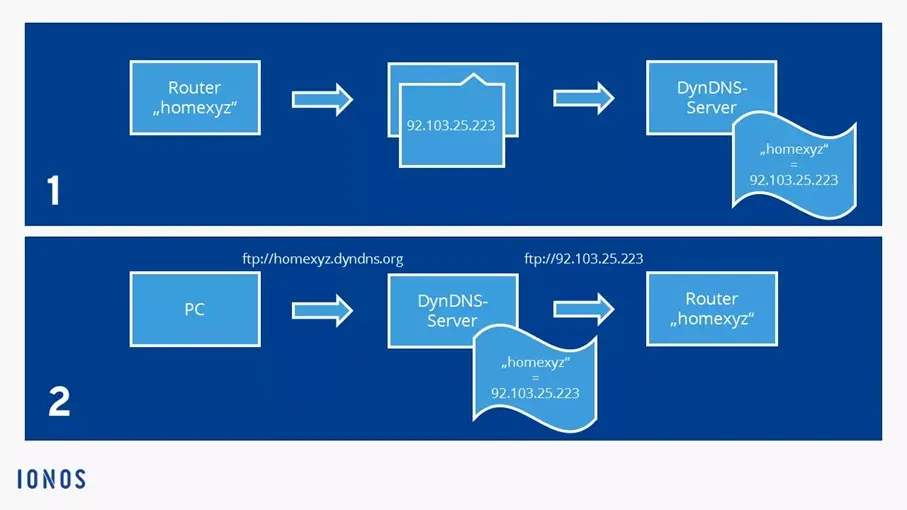
As addressing is generally done with domain names and not with IP addresses, you need a dynamic DNS that updates the IP addresses that change constantly and then assigns them to a fixed domain name. As soon as the router's IP address changes, The router reports the current IP address at the DDNS servicewhich updates the DNS request under its own domain and responds to the IP address. If you now establish a connection to your computer, this procedure is following:
- The router notifies the DDNS service of the IP address awarded by the access provider. This is attributed in the Dyndns in the domain name you have specified. With this area, the local server is now accessible at any time.
- If the IP address changes after 24 hours, the DDNS service will receive automatically The new IP address. The DDNS server responds to DNS queries and updates the new IP address under the fixed field.
- If you want to connect to your computer (for example via a remote desktop connection), send a DNS request to your registered field. The DDNS server automatically delivers the current IP address of your Internet access provider stored under the name.
A customer-server connection is now possible with the IP address obtained. Ideally, this must be made via a connection encrypted by HTTPS or via a VPN to protect your data against unauthorized access. Modern DDNS services also offer two factors authentication (2FA) to further secure access to your network. These options should be used when sensitive data or devices are accessible from outside.
Advice
You must first configure the your router settings So that the function Dyndns either well taken into account by the latter. Under the name of your router, simply check the « Use Dyndns » tab in the Internet menu> « Share » then enter your Dyndns address and the associated identification data that you received during the registration via the DDNS service. Just save and it's over!
Possible uses of the dyndns
The possibilities of applying the dyndns are multiple. For example, you can:
- Access your computer while you are on the go (for example via a remote desktop connection)
- Manage several operating systems on one device and send your files on the Internet
- Provide continuous media (streaming))
- Access your email server or other files from the company's computer
- Check access to smart home systems such as heating control or IP cameras
- Manage IoT devices remotely.
In addition, many other remote access scenarios via the DDNS services are possible. The Dynamic Domain Name System (Dyndns) greatly facilitates the use of computers on a daily basis.