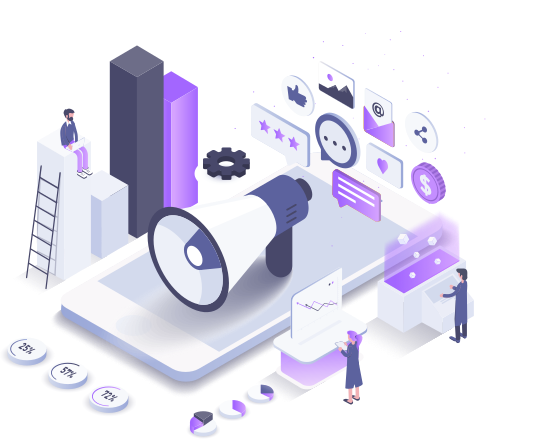
The customer life cycle refers to the journey over time of the commercial relationship between a company and an individual. This therefore corresponds to the period between the first and last contact. As part of customer relationship management (CRM), you make the different phases of the customer life cycle more concrete in order to increase long-term customer satisfaction and loyalty.
Summary
- The customer life cycle describes the journey over time of a commercial relationship, from the first to the last contact.
- There is no universal definition of phases; A possible model has six phases, from awareness to re-engagement.
- Not every client has to go through all the phases.
- Marketing automation helps collect information and aims to personalize communication with customers as much as possible, even as the customer base grows.
- With a CRM platform, you store all information centrally, making collaboration between marketing, distribution and sales easier.
What is the Customer Lifecycle?
The Customer Lifecycle (CLC) is a concept that considers the customer relationship as a continuous and long-term process. Customers go through different stages, from first contact to the moment when the business relationship is definitively ended.
During the customer lifecycle, every contact between the customer and the company should be considered a possible trigger for further interaction and purchasing processes.
The customer life cycle plays an important role in so-called CRM (Customer Relationship Management). Here, a detailed look at the different phases of the cycle helps to optimize long-term customer loyalty and satisfaction. In addition, the knowledge acquired can be used for advertising retargeting or customer prospecting.
Sometimes customers can be won back, even after the business relationship has ended, and the Customer Lifecycle can then start again.
IONOS AI email assistant
Your mailbox responds automatically thanks to AI.
-
Save time: automatically respond to common emails
-
Stay available: instant responses, 24/7
-
Maintain full control: you decide what is automated
Customer life cycle: what are the different phases?
The customer lifecycle consists of different phases. However, there is no universal definition, which is why there are different models with varying numbers of phases. One possible model is a six-phase cycle.
Note
Regardless of the basic model for the phases of the customer life cycle, it is important to know that every individual does not necessarily have to go through all the phases. These are only standard models to be adapted specifically to the observed behavior of each individual.
Phase 1: recognition / awareness
During the first phase, you deal with potential customers. They find out about certain products, compare suppliers, offers or models and, in case of doubt, reconsider or postpone their purchasing decision. This involves drawing the customer’s attention to your offer through classic marketing measures, for example:
- Search Engine Optimization
- Advertisements
- Affiliate programs
- Competition games
Phase 2: trust / acquisition
With a design adapted to the style of your business, quality photos and product descriptions and above all personalized dialogue, you end up gaining the trust of consumers. Reliable evaluations from other customers or other certification bodies also help to convince.
If you have answered all questions regarding data protection, the ordering and delivery process and the desired payment method is available, you have a good chance of complete the purchase. Regularly analyze bounce rates and when they occur to know where you can improve your website.
Advice
Do you want to collect huge amounts of data about your customers and leverage it for digital marketing purposes? To do this, use a Data Management Platform!
Phase 3: purchase / conversion
Then comes the most important phase of the customer life cycle: he buys a product or a service and thus officially becomes a client. It is important that the entire conversion process goes as smoothly as possible.
After convincing the new customer that you are a trustworthy partner, it is important to show that their trust is deserved. In concrete terms, this means, for example, that you must keep all promises regarding the condition and delivery of the goods or communicate possible complications appropriately.
Thank customers for the trust they have placed in you and, for example, leave room for comments and complaints.
Phase 4: engagement / retention
While the previous measures are common and often applied, now comes one of the most important aspects of customer relationship management. In the retention phase, you can outperform your competitors by showing originality and creativity and ensuring that the customer life cycle is particularly long. To do this, you can, for example, propose the following solutions:
- Bonus, points and bonus systems
- Competitions, draws
- Vouchers, gifts
- Special offers, discount actions
- Special conditions, e.g. reduced delivery times
Also seek dialogue with loyal customers, including regularly measuring customer satisfaction and taking into account their wishes for improvement. Also respond to your customers’ comments on social networks like Facebook or X. If you ignore your followers and use the platform only for marketing purposes, this will quickly lead to negative repercussions on your reputation.
For many businesses, social networks represent the best way to increase their visibility and communicate directly with potential customers.
Advice
Apart from social networks, you can also inform your new customers of what you have to offer them: use emailing software to present new or interesting products in personalized newsletters.
Phase 5: loyalty
If a customer is satisfied with an offer and the services offered, this increases the chances of further purchases. In the long term, your customers become ambassadors for your brand. In the best case scenario, loyalty is not only reflected in repeat purchases, but also in the fact that a customer recommends your products and services on their own.
This recommendation marketing helps, among other things, to strengthen credibility and convince new potential customers more quickly.
Phase 6: recovery / re-engagement
If customers have not made a purchase for a long period of time, they are considered lost buyers. We must therefore recover this clientele. For example, try to convince them to come back by contacting them individually by phone or email. Where possible, tie this to special conditions such as a discount or free delivery to create additional incentive.
Note
In France, since August 11, 2026, telephone canvassing of consumers is in principle prohibited without their prior consent (Consumer Code, art. L. 223-1), except when the call concerns a current contract and is related to the subject of this contract. For prospecting emails addressed to individuals, the Postal and Electronic Communications Code (CPCE, art. L. 34-5) in principle requires prior consent, with a possible exception for existing customers when it comes to similar products or services.
The role of marketing automation in the customer lifecycle
It is important to integrate the customer lifecycle into marketing and sales processes. Provide the customer with exemplary service and support is what will set you apart from other businesses. However, this presents a huge challenge for businesses, especially in the beginning when they have to deal with a large number of potential new customers.
In this case, the solution is to automate the individual work steps and processes using marketing automation tools. Such programs help on the one hand to collect and analyze information. On the other hand, marketing automation aims to personalize the customer approach and marketing as much as possible within the customer lifecycle, even if the customer base grows.
For the company, the use of such solutions represents a lot of work at the beginning, but will later save a lot of time and money.
Customer lifecycle and CRM: in perfect harmony
Constant observation and optimization of the Customer Lifecycle is an elementary pillar of customer relationship management (CRM). This discipline is closely interested in how companies can improve and intensify interaction with customers via different means of communication.
It is therefore not surprising that CRM tools also offer the functionalities necessary for optimizing the customer lifecycle. A professional CRM tool makes it possible to achieve the following objectives in particular:
- Optimal adaptation of the customer life cycle, according to the latter’s expectations
- Automation of personalized communication with customers
- Exploitation of touchpoints in the different phases of the customer life cycle
The main advantage of combining the customer lifecycle and CRM platform is that you can store and record all information and knowledge centrally. This not only facilitates collaboration between different departments such as marketing, distribution or sales, but also helps you keep an overview of your customers.
In summary
If you take a close look at the customer lifecycle, you’ll get a bird’s-eye view of how your brand is perceived. By specifically observing different customers and combining it with CRM, you can further develop your company’s marketing.