
If you want to run a website or an online store, sooner or later you will face the challenge of finding a suitable web address. Between different types of domains and a multitude of extensions, the choice can quickly become complex. Find out more in the rest of this article.
Domain name
Your domain in one click
-
1 Wildcard SSL certificate per contract
-
Included Domain Connect feature for simplified DNS setup
What are the different types of domain extensions?
A memorable web address and domain always consists of a relevant name and a suitable domain extension. We present to you the main categories to know to prepare for registering a domain.
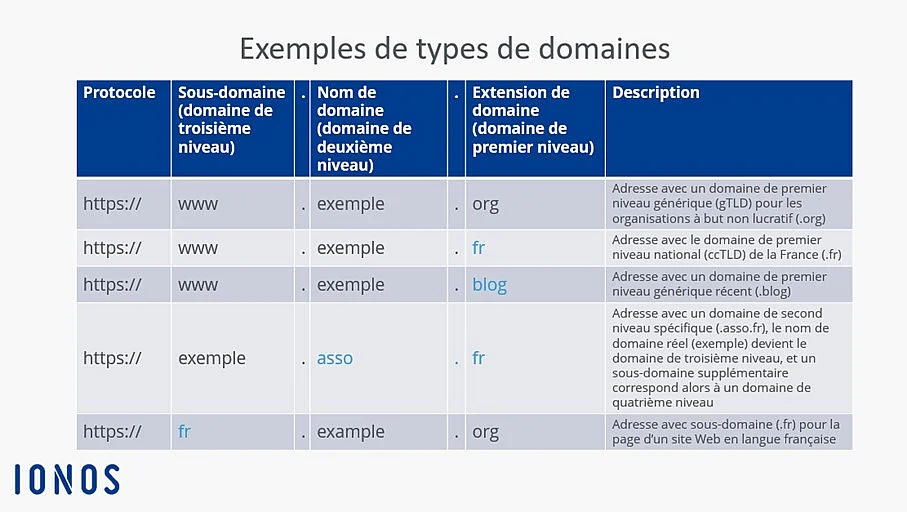
Variant examples of an Internet address show different types of domains, which will be explained in more detail below.
Domain type 1: Top-level domain (TLD)
Top-Level-Domain (TLD) constitute the upper level of the Domain Name System and are found at the end of a web address, such as .fr, .com Or .org. TLD assignment is managed by IANA, a department of the Internet Corporation for Assigned Names and Numbers (ICANN), founded in 1998. IANA defines available domain extensions and delegates their management to registries, which then work with registrars and domain providers to market more than 1,400 domain extensions today, including classic TLDs, national extensions and modern theme extensions.
Examples of original TLDs:
| Original TLD | Meaning of Domain Extension |
|---|---|
| .com | Commercial offers |
| .org | Nonprofit organizations |
| .net | Internet Service Providers |
.edu
|
Educational institutions (mainly in the United States) |
.int
|
International organizations |
.gov
|
US government institutions |
.mil
|
US Army |
Domain type 2: ccTLD (country code Top-Level-Domains)
ccTLDs are national domain extensionscomposed of two letters, like .fr (France) or .es (Spain). Each country sets its own registration rules, which may influence access and use of these domains. Some states actively promote their ccTLDs, such as Tuvalu with .tv.
The following table presents, as an illustrationdomain name examplesome national extensions:
| National domain extension | Meaning |
|---|---|
.ch
|
Swiss |
.cn
|
China |
| .of | Germany |
.es
|
Spain |
| .fr | France |
.it
|
Italy |
.ru
|
Russia |
.uk
|
United Kingdom |
.us
|
UNITED STATES |
Note
Internationalized domain names (IDNs) are also growing in popularity. They incorporate special characters, accents or non-Latin alphabets, which makes it possible to create web addresses adapted to local languages. Technically, they are converted to Punycode to remain compatible with the DNS system.
Domain type 3: gTLD (generic top-level domains)
gTLDs correspond to types of topic areas which are not linked to a geographical area. There are two main categories among these extensions:
THE Unsponsored gTLDs are managed centrally by ICANN, in collaboration with various partners. Originally, their allocation was subject to strict conditions. For example, the domain .net was reserved for Internet service providers. Today, like many other unsponsored gTLDs, it is accessible to a wide audience, including businesses, organizations and individuals.
| Unsponsored gTLDs | Initial Meaning of Domain Extension |
|---|---|
| .biz | Businesses |
| .info | Information sites |
| .name | Individuals |
| .pro | Specific professions |
| .education | Educational institutions |
THE Sponsored gTLDson the other hand, are subject to the rules defined by their sponsoring organization. The entities concerned ensure both the management and control of these extensions.
| Sponsored gTLDs | Meaning of Domain Extension |
|---|---|
.travel
|
Tourism |
museum
|
Museums |
.aero
|
Aviation sector (international) |
.jobs
|
Company job offers |
New top-level domain extensions like .blog, .web Or .beauty are also part of the gTLDs and offer many possibilities for creating an example domain name relevant to your activity.
Domain type 4: second-level domain (SLD)
The second level domain corresponds to domain name itselfthat is to say the part located before the TLD (exemple.com : exemple is the SLD, .com is the TLD). It plays a key role for branding and SEO, as it clearly reflects the content or activity of your project. Registration of a second-level domain is always done in combination with the chosen domain type (Top-Level-Domain).
Some countries offer specific structures combining second level and TLDas the following examples show:
| Examples of country-specific LTC | Meaning of Domain Extension |
|---|---|
.gouv.fr
|
French government institutions |
.asso.fr
|
Associations in France |
.edu.eu
|
Educational establishments within the European Union |
Domain type 5: third-level domain (subdomain)
Third-level domains, better known as subdomains, sit before the second-level domain and help structure a website or separate different sections.
Examples of third-level domains :
fr.example.org(French version)de.example.org(German version)en.example.org(English version)blog.example.org(blog section)app.example.org(web service or application)
Subdomains allow you to clearly organize content without having to register a new domain name.
How to choose the right field?
A good understanding of the different types of domains and domain extensions helps you choose a user and search engine friendly web addressadapted to your project, without unnecessarily complicating the address. We have put together the essential tips for you.
Tip 1: Find the right domain extension
The domain extension (Top-Level-Domain) influences user expectations and must therefore correspond to your project:
.shopfor E-commerce.blogfor a blog.frfor an activity in France- etc.
Always choose a domain extension that speak to your target and reflects the content of your website.
Tip 2: choose a clear and memorable domain name
A good domain name should be short, clear and easy to remember. The more concise the address, the more users can remember and type it without errors. This reduces typos and improves the visibility of your website in the long run.
Tip 3: Use subdomains only if necessary
Subdomains are useful when you need to clearly structure different content. For small websites, they are not always relevant. Use a third domain level only if it meets a specific need. A subdomain is particularly suitable in the following cases:
- Distinction between different language versions
- Separation of content fromadditional offers such as a service, blog or forum
- Setting up a specific web service like an application or FTP server
- Management of a online store alongside website under the same second-level domain
Tip 4: Check availability and legalities
Check that the desired domain name is available. Common variants or combinations with other extensions can be quickly reserved. Also make sure that the chosen name does not infringe on existing trademark rights in order toavoid any legal conflict.