
What is RankBrain, and how does it change Google Search? Since 2015, Google has relied on the self-learning AI system RankBrain to interpret search queries. It helps identify user intent, even for new or complex search terms, and provide tailored results. The algorithm is based on machine learning and is considered part of Google's long-term AI strategy, of which DeepMind is a part.
AI tools
Harness the full power of artificial intelligence
- Create your website in record time
- Boost your business with AI marketing
- Save time and get better results
What is RankBrain? Definition
RankBrain is a self-learning AI system used since early 2015 as part of Google's parent search algorithm, called « Hummingbird. » The main task of RankBrain is to interpret keywords and search phrases for the purpose of determining user intent.
Google estimates receiving approximately 8.5 billion requests per day via web search. About 16% of these queries are keywords and keyword combinations that have never been submitted to Google in this form, including colloquialisms, neologisms, or complex long-tail phrases.
Note
When Google refers to RankBrain as a “self-learning AI system,” it means weak artificial intelligence. It is a technology that finds automatic solutions to problems that previously had to be handled by humans. Like most systems of this type, RankBrain uses machine learning techniques.
RankBrain helps Google interpret data entered by users and find in theGoogle search index (a database of approximately 100 million gigabytes) the websites that best match users' search intent. The AI system goes far beyond simply comparing search terms.
Instead of independently analyzing each word in a search query, RankBrain captures the semantics of all user input and thus determines theintent of the searching user. Even though it's a long-tail phrase, you get the answer you're hoping for in the blink of an eye.
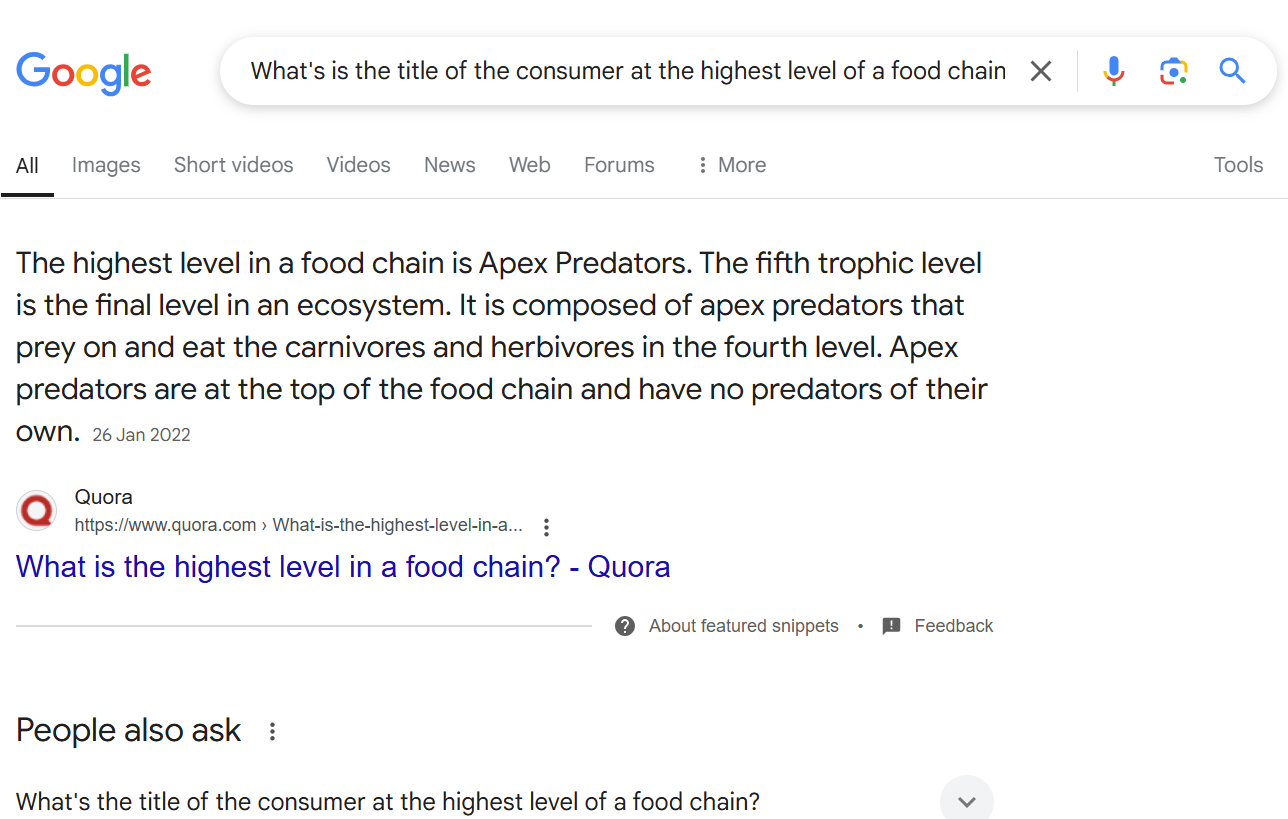
RankBrain, as a machine learning system, builds on its experience from previous research. It builds connections and predicts based on that what the user is looking for and the best way to answer their query. It can resolve the ambiguities and decipher the meaning of unknown terms (like neologisms).
However, Google does not specify how RankBrain addresses this challenge. SEO experts suggest that it uses word vectors to translate search queries into a form that allows computers to interpret meaning relationships.
What is the basis of RankBrain's semantic analyses?
According to several statements from Google engineers, RankBrain is based in part on concepts such as Word2Vec and uses similar vector space techniques to capture the meaning of words. Indeed, in 2013, Google published open source machine learning software Word2Vecwhich allows semantic relationships between words to be translated into a mathematical representation, measured and compared. This analysis is based on corpus of linguistic texts.
Creation of vector space
To “learn” the meaning relationships between words, the first step in Word2Vec is to create a vector space n dimensions, in which each word of the underlying text corpus (we speak of “training data”) is represented as a vector. n indicates the number of vector dimensions in which a word should be represented. The greater the number of dimensions chosen for the word vectors, the more relationships with other words the program captures.
Vector space adjustment
In the second step, the created vector space is injected into a artificial neural network (RNA) which allows it to be adapted using a learning algorithm, so that words used in the same context also form a similar word vector. The similarity between word vectors is calculated using the cosine distance as a value between -1 and +1.
The role of Word2Vec
If you give Word2Vec any corpus of text as input, the program provides the corresponding word vectors as output. These make it possible to evaluate the proximity or semantic distance of the words contained in the corpus. If Word2Vec is faced with a new entrythe program is capable, thanks to the learning algorithm, of adapting the vector space and thus establishing new meaning relationships or rejecting old hypotheses: the neural network is “trained”.
Officially, Google does not link the operation of Word2Vec to the RankBrain search algorithm component, but it can be assumed that the AI system relies on similar mathematical operations.
Advice
Using artificial neural networks, researchers attempt to simulate the principles of organization and processing of the human brain. The objective is to develop systems capable of handling vagueness or imprecision in problem solving, and therefore of carrying out tasks previously reserved for humans. Neural networks are used by Google for automatic image recognition, for example.
RankBrain as an SEO ranking factor
Even more surprising than the announcement of the integration of Google artificial intelligence searches into web search is the extent of this integration: since 2016, all queries have been interpreted by RankBrain.
Note
According to Andrey Lipattsev, Search Quality Senior Strategist at Google, RankBrain was previously the third most important ranking factor. But since then, Google's algorithm has evolved and is now complemented by BERT and other AI technologies.
For website owners and SEO experts, it is mainly the view on keyword strategies that has changed. Inasmuch as semantic search engineGoogle is able to rely on background knowledge in the form of concepts and relationships to determine the meaning of the content of texts and search queries. Thus, the ranking of a website for a given keyword depends less on the presence of that keyword and more on the relevance of the (textual) content of the website to the concept that RankBrain associates with the keyword. The emphasis is therefore not on the keyword itself, but on the relevance of content of the site.

Thanks to RankBrain and the continued development of BERT and other technologies, content relevance and user intent are even more central to search engine optimization.
AI modules that complement RankBrain
RankBrain was launched in 2015 and was considered a breakthrough in Google's interpretation of search queries, but the technology has evolved since then. Today, RankBrain remains an important part of Google's algorithm, particularly for interpreting search terms and determining user intent. However, it is no longer the only factor determining the interpretation of search queries.
BERT in support of RankBrain
In 2019, Google introduced BERT (Bidirectional Encoder Representations from Transformers)another AI model that complements RankBrain in processing natural language input. While RankBrain helps in particular with the semantic analysis of long-tail search terms and unknown word combinations, BERT is more involved in contextualizing complete sentences and taking into account the meaning of words in their specific context.
MUM and other AI technologies for interpreting search queries
Besides RankBrain, Google now relies on other AI models such as BERT And MUM (Multitask Unified Model) to better understand search queries. It is especially complex or ambiguous questions that benefit from these developments. MUM is able to combine information from different sources and formats (such as text and images) and relate them in a meaningful way.
Even though Google has never fully revealed how RankBrain, BERT And MUM interact, it is clear that semantic search technology has evolved significantly.
Important AI modules in Google algorithm:
- RankBrain interprets search queries, especially new or unusual wording.
- BERT analyzes the context of words in search queries (e.g. sentence structure).
- MUM understands complex search intents and combines content from different formats.
This therefore means that classic SEO, with keywords and technique alone, is no longer enough. What is decisive today is a high-quality, user-centric contentwhich takes into account thesearch intentof context and the semantic relevance.