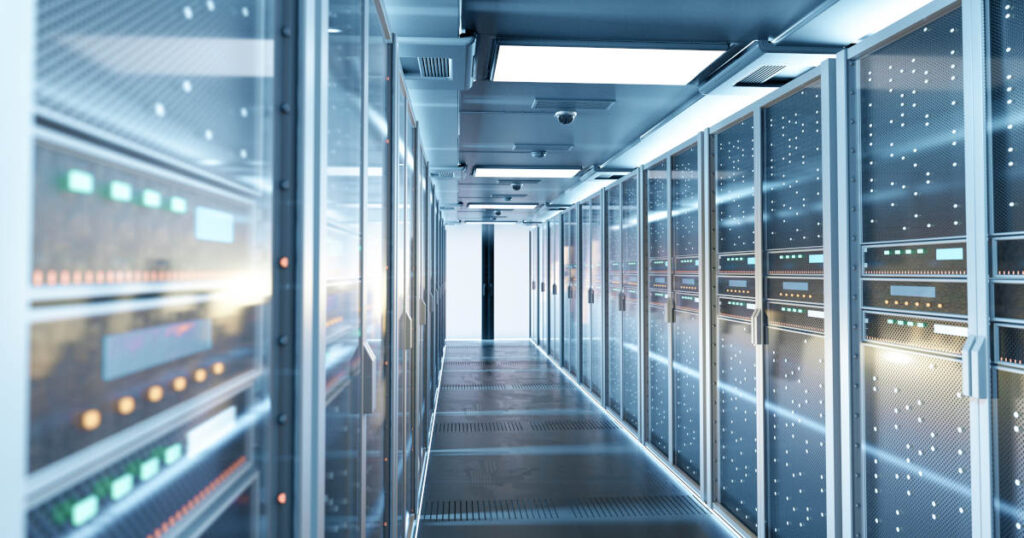
A data center is a facility where a large amount of IT infrastructure such as servers, storage and networks is centralized. It is used to process, store and secure data for businesses, Cloud services or Internet applications.
Dedicated servers
Performance and innovation
- Latest generation processors
- High performance dedicated hardware
- ISO certified data centers
Definition of a data center
To simplify, a data center (or data center in English) is a physical location, in most cases a free-standing building, in which the sensitive data and applications are stored in bulk. It is a network of computing and storage resources, such as routers and servers, which makes this data available. Thus, businesses or Internet service providers can operate the entire IT infrastructure and data processing efficiently and securely.
Data center infrastructure has evolved significantly since its inception. The computing power of traditional on-premises physical servers has been combined with the flexibility of virtual servers : Most data is currently attached to several private and public data centers and Clouds. This is why a modern data center must now be able to communicate with different sites. Another trend is theEdge Computing : Data is processed directly where it is used, reducing latency and reducing network capacity. Smaller, local data centers thus complement large Cloud sites.
Why do businesses need data centers?
Most applications and business activities within an enterprise generate data that must be stored. We can notably cite:
- Email and file sharing
- Productivity apps
- Websites
- Online transactions
- Data from CRM tools
- Enterprise Resource Planning (ERP)
- Databases
- THE Big Data and artificial intelligence
- Virtual offices
- Communication and collaboration services
Large companies accumulate gigantic volumes of data which require a lot of servers and storage space. A server room is generally not enough to manage all data flows. Additionally, maintenance can be difficult. High energy costs and, in some cases, constant monitoring to prevent server outages and cyberattacks are draining some companies' resources.
This is where data centers come in: data is stored in a secure place and under constant surveillance. They have a thermostat which helps prevent overheating of the servers. At the same time, the emergency power supply ensures that data is protected against failures. Depending on the type of data center, businesses typically only pay for the space they use and the electricity they consume. They spend less time managing administration and infrastructure and can focus more on their core business.
What functions does a data center perform?
The tasks of a data center differ depending on its location, owner and scope. Even if they are managed in service or in colocation, clients require different IT tasks. Storage for data backup At storage and execution of fundamental IT processesa data center can perform a large number of tasks.
Thus, a data center acts as a networking interface which connects the different shared living environments. This is, for example, important in streaming of film, where a CDN (Content Delivery Network) networks a colocation environment with an Internet Service Provider (ISP).
Conversely, Hyperscale and Wholesale data centers are optimized for the needs of individual businesses and particularly suited to large enterprises.
What are the basic components of a data center?
For a data center to function optimally, it needs multiple components that work effectively together.
Computer hardware
Computer hardware is the most important element of a data center. It contains all the components necessary for network operation and data storage. Computer hardware is divided into four categories:
- Server hardware: from powerful processors (CPU) to fast RAM, including large capacity hard drives and even dedicated graphics cards (for GPU servers), server hardware brings together all the technical components that make up individual computers.
- The active components of the network: devices like routers, switches, firewalls (hardware) and other controllers that are necessary for the operation of an active network and require an active electrical connection are called active network components.
- The passive components of the network: the data center also needs passive components to operate a network. Unlike active components, passive components such as cables, sockets and trunking do not need their own electrical connection.
- The frames: hardware as well as network components are secured in metal enclosures, called chassis or racks. The standard dimensions of 19 inches ensure rack compatibility with all modules.
GPU servers
Dedicated hardware with a powerful graphics card
Use GPU computing power flexibly to handle large amounts of data and only pay for the resources used.
The staff
Even though most data centers are now largely automated, the human staff is essential. Servers, network and infrastructure must be constantly monitored, as this is the only way to avoid outages or quickly resolve problems when they arise. Staff tasks are divided between the areas of engineering and systems administration:
- Systems engineering concerns all electrotechnical tasks in a data center. In particular the installation of devices, the replacement or repair of defective equipment as well as the connection of components.
- Systems administration concerns the configuration of the system on the server and the monitoring of operation. In addition, it also concerns security and data protection in the data center.
Infrastructure components
The last thing needed for smooth operation of the data center are the individual components of the infrastructure. Depending on the structure and equipment of the building, they can be very different.
- Environmental control: Maintaining an optimal temperature is essential. A large number of servers generate a large amount of heat which, if uncontrolled, leads to overheating and server failure. State-of-the-art systems and architectural measures ensure an efficient cooling cycle and optimal temperatures in the data center.
- Power supply: without electricity, no data center. This is why it is essential to ensure a constant supply of electricity. This is achieved on the one hand by redundant electrical connections. On the other hand, a battery can compensate for short-term power outages, while a dedicated diesel generator takes over in the event of a longer-term power outage.
- Security technologies: in order to protect sensitive data, only authorized people must have access to the data center and must identify themselves using a badge or fingerprints. In addition, a modern video surveillance system is necessary, as it allows personnel to constantly monitor the facility. To ensure the protection of personnel and equipment in the event of fire, modern protection systems must be used.
Advice
To counter the high electricity consumption of data centers and meet legal requirements linked to the increase in computing power, as provided for by the energy efficiency law, many service providers are banking on “green data centers”. This requires modern equipment with optimized technology, sustainable electricity and Green IT certifications.
The different types of data centers and their management
There are different types of data centers that are managed differently depending on their purposes. Different factors determine which type it is: is the data center used, for example, by one or more companies? What technology is used for data processing and storage? What about energy efficiency? We differentiate four main types of data centers :
- Corporate data centers: these data centers are designed for a particular business and optimized for their end user. The data center is owned by a company and is usually located on the company's premises. Thus, the company is responsible for the maintenance and management of the IT infrastructure and components.
- Data centers in managed service: they are maintained and administered by a third party on behalf of a company. The company rents all equipment and infrastructure and therefore has no additional expenses.
- Colocation data centers: in this case, unlike those in managed service, a company only rents a room in a data center with existing infrastructure (air conditioning, bandwidth and security measures). Things like the server, storage media, and firewalls are managed by the company.
- Cloud data centers: In this off-site variant of a data center, public cloud providers such as Amazon Web Services (AWS), Microsoft (Azure) or IBM Cloud host the data and applications. Maintenance and administration are completely managed by the providers.
What is the difference between a data center and a server room?
A data center generally occupies a whole building and is equipped with servers, storage media and all the necessary structures. A server room generally only occupies one room of a building. Especially for small and medium-sized businesses, where data volumes and applications can be controlled, server rooms are a good alternative to a complex data center. Many of them now offer equipment similar to that of a data center, with security and supply being the responsibility of the building owner or tenant.