
UTM parameters are tracking tags added to URLs to identify the origin and performance of website traffic through analytics tools like Google Analytics. Without UTM trackingthe analysis remains vague and incomplete. For example, you will know that traffic is coming from Instagram, but not if it is coming from posts on your own page or another source.
What exactly are UTM parameters?
The acronym UTM comes from the predecessor of Google Analytics, called Urchin Tracking Monitor. UTM parameters, also called UTM codes, allow you toaccurately identify the origin of each click in an analysis tool such as Google Analytics: how many clicks come from your last Instagram post? How much for a display campaign? How much is organic search on Google, etc.? ?
Technically speaking, UTMs are simply URL parameters (or query strings), added at the end of a link. In the example below, all elements after the question mark constitute the UTM parameters:
https://ionos.com/digitalguide/example?utm_campaign=alfa&utm_medium=social&utm_source=facebook&utm_content=cta1Advice
You will find a detailed explanation of the different parameters of a URL in our article on HTTP requests.
Each UTM parameter is introduced by the prefix utm_ and consists of a key-value pair separated by an equals sign. For example :
UTM parameter values can be freely definedbut it is recommended to use standardized terms like “instagram”, “newsletter”, “internal”, “announcement”, etc.
Like any other query string, the different parameters are chained using the character & after a question mark (?) placed at the end of the base URL. A URL can of course contain other parameters than UTMs. However, thanks to the prefix utm_Google Analytics automatically identifies tracking parameters and isolates them from the rest of the query.
rankingCoach
Boost your sales with AI digital marketing
- Improve your ranking on Google without the expense of an agency
- Respond to customer reviews and generate posts for networks
- No SEO and online marketing knowledge required
UTM parameters in detail
There exists six UTM parameterstwo of which are mandatory: utm_source And utm_medium. You absolutely must use them together. It is not permitted to indicate only utm_sourceFor example. The other parameters (utm_campaign, utm_term, utm_content And utm_id) are optional and can be added as needed or omitted completely.
utm_source
The parameter utm_source serves to indicate the traffic sourcei.e. the site or platform that redirected the user to your page. This could be, for example, the name of a social network, an email sending tool or a partner blog.
Important : avoid using your own domain name as a value for utm_sourceas this would confuse the analysis data. Prefer a designation like “internal” for internal links.
utm_campaign
This parameter is used to identify the marketing campaign to which a link belongs. It allows you to evaluate the overall performance of a campaign in Google Analytics, across all channels and media. Choose a clear campaign name that is easily understood by your entire team.
utm_medium
utm_medium indicates the marketing or advertising medium used. This could be a display ad, a newsletter or a blog post. Google recommends using broad, standardized terms like « email, » « cpc, » « display, » or « social » to avoid confusion in reporting.
utm_content
When several contents are used in the same campaign (for example two different banners), utm_content allows you to distinguish them and analyze their performance respective. You can therefore name your content in a differentiated way, for example: utm_content=slogan1 And utm_content=slogan2.
utm_term
This setting is designed for paid search campaigns (SEA). It allows you to specify the keyword that triggered the ad. On Google Ads, this field is optional, because the platform fills it in automatically. On the other hand, it remains useful on other engines like Bing to distinguish paid traffic from organic traffic.
utm_id
With utm_idyou can assign a unique identifier to your marketing campaign. This setting is particularly relevant for associating campaigns with precise tracking data, especially in Google Ads. It is also useful in third-party advertising networks or partnerships, to ensure consistent attribution and consistent analysis in Google Analytics.
Configure UTM parameters
The easiest way to configure UTM parameters is to use the Campaign URL Builder.
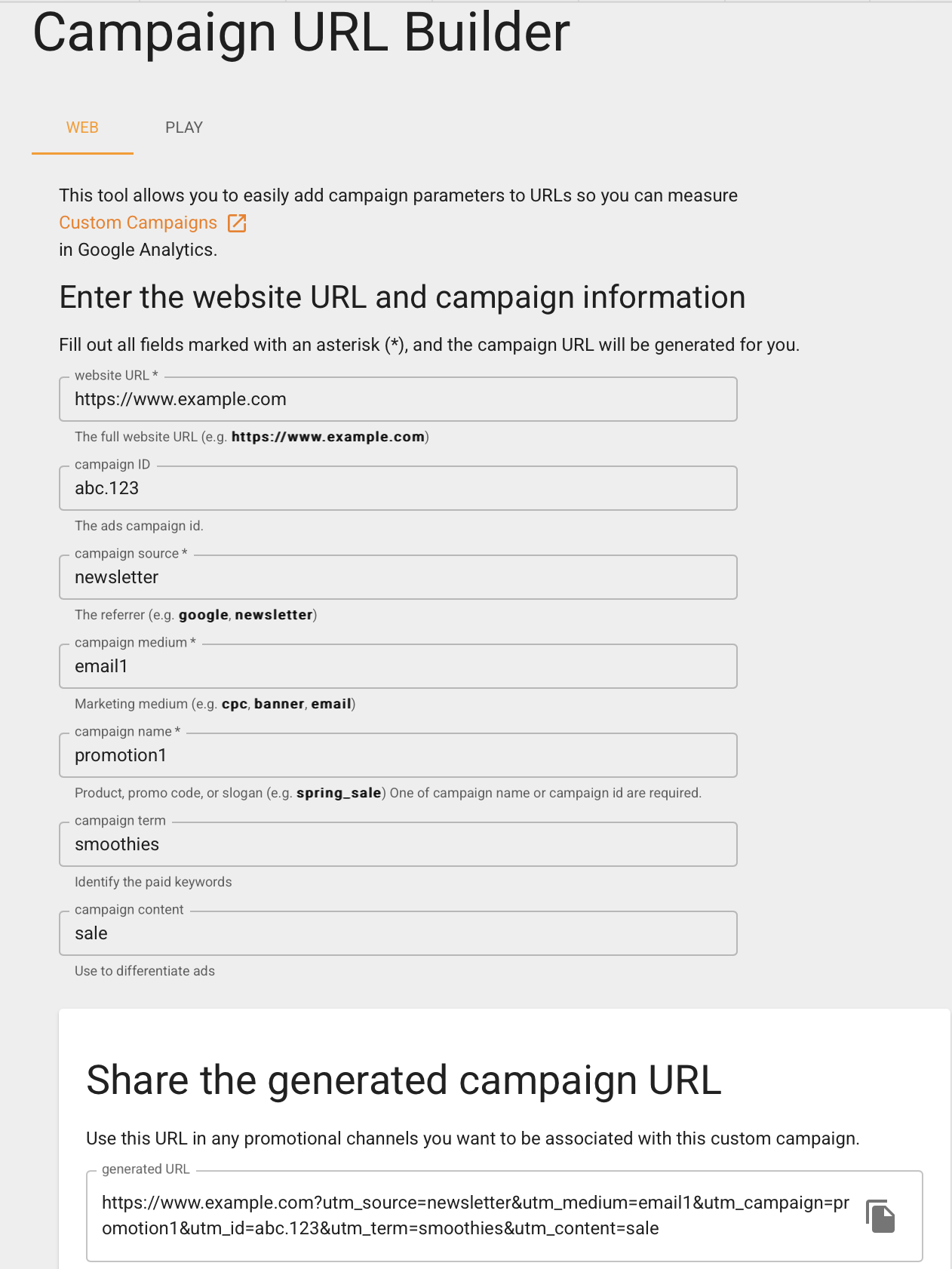
The URL generated by the tool (a URL with a query string attached) can be copied/pasted. In our example, the URL would be used as a link call to action a promotional email. To avoid unnecessarily overloading the user with overly detailed information, it can be shortened with the optional tool. The “Shorten Link” button redirects to Bitly, where you must first create an account to shorten your URLs.
Evaluate UTM parameters
In Google Analytics, you will find the values of the UTM parameters you defined under “ Acquisition > Campaigns > All campaigns « . There you can evaluate the previously saved settings.
Email marketing
Create newsletters and generate sales
- Drag-and-drop and AI features for intuitive design
- Many professional models to choose from
- Sending simple, GDPR-compliant emails