Random forest is a machine learning algorithm that combines multiple decision trees to improve results. It is one of the most reliable methods for classification and regression. In particular, it offers beginners an opportunity to develop their first models successfully.
Random forest: what is it?
Random forest is a machine learning algorithm where multiple decision trees combine their results to provide a more precise answer. Rather than relying on a single tree, this method uses predictions from many models, improving overall accuracy. Each tree is trained with slightly different data or features, which increases the diversity of the model. The idea is that although each tree may be imprecise in isolation, their combination forms a stable overall model. The random forest is less sensitive to overfitting, because the diversity of trees compensates for their individual errors. The algorithm can be used for classification and regression, and it works effectively even with data with many features or incomplete information.
AI tools
Harness the full power of artificial intelligence
-
Create your website in record time
-
Boost your business with AI marketing
-
Save time and get better results
How does the random forest algorithm work?
The random forest algorithm starts by generating several random samples from the original dataset, a process called bootstrapping. For each sample, a separate decision tree is then trained. It is crucial that each tree uses a random part of the available features, which allows models to be differentiated. Each tree is created independently of the others, and small differences in the data can greatly influence its structure. For classification, each tree issues a class decision; for regression it returns a numeric value.
After training, the tree results are combined : in classification, the final decision is the one which receives the most votes; in regression, the average of the results is taken. This process reduces the impact of outliers, which minimizes overfitting, because errors in one tree are compensated for by others. Additionally, the algorithm evaluates the importance of each feature in the prediction, making the model easier to interpret.
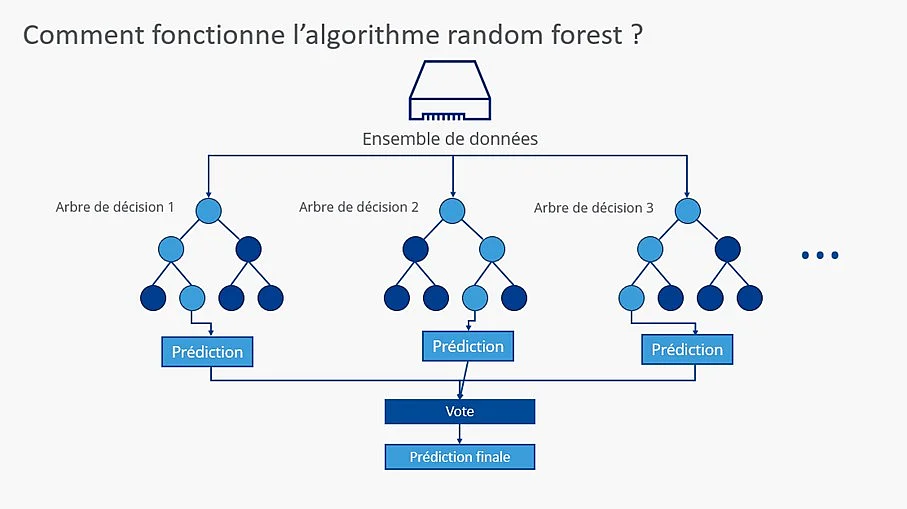
With the random forest algorithm, the results of several decision trees are combined in a vote to obtain a final result.
What are the advantages and disadvantages of the random forest algorithm?
The random forest appeals with its high precision, flexibility and stability, but like any algorithm, it also presents challenges.
Advantages of random forest
The random forest generally provides very precise resultseven if your data contains many variables or a lot of noise. As the algorithm combines multiple models, overfitting occurs much less frequently than when using isolated decision trees. Additionally, a random forest can effectively manage missing values and remains stable even if the data quality is not optimal. The ability to assess the importance of variables is particularly useful, as it provides valuable insight into the structure of the data. Furthermore, the algorithm is very flexible and can be used for both classification and regression tasks.
Disadvantages of random forest
Despite its advantages, random forest presents certain challenges. When the model contains a very large number of trees, the computational load increases significantly, which can lead to longer training times. Interpretability is also limited, as a complete forest of decision trees is not easily understood. This makes the detailed explanation of decisions more complex, especially in areas where transparency is essential. The random forest can also reach its limits in the face of real-time requirements because the prediction must traverse multiple trees. Finally, on particularly large datasets, the model may require a lot of memory space.
Advantages and disadvantages of random forest: comparison table
| Benefits | Disadvantages |
|---|---|
| ✓ High precision and robustness | ✗ Lower interpretability |
| ✓ Little overfitting | ✗ High computational load for large models |
| ✓ Works well with many features | ✗ Slower predictions with very large numbers of trees |
| ✓ Handling missing values | ✗ Greedy in memory |
| ✗ Less suitable for strict real-time requirements |


What are the typical use cases of random forest?
The random forest algorithm is used in many industries due to its reliability, robustness and versatility. It is particularly beneficial when there are large amounts of data, many features or complex patterns to analyze.
Credit and risk assessment
Banks use random forest in their artificial intelligence systems to estimate the probability of a payment default. The algorithm can combine data such as income, payment behavior, length of employment or credit history. Thanks to its robustness, it detects patterns that humans, or even simple neural networks, might not perceive. The multiplicity of trees ensures that random outliers do not influence the decision. This is particularly important for making fair and stable decisions.
Medical diagnosis
In the healthcare sector, random forest is frequently used as part of AI-assisted diagnosis. It can combine laboratory values, symptoms or image characteristics in order to make predictions about diseases. As medical data is often incomplete or noisy, this area benefits greatly from the robustness of the algorithm. In combination with other models, such as a neural network for image analysis, it becomes possible to build reliable global systems.
Fraud detection
Companies use random forest, among other things, in AI-based fraud detection systems to identify fraudulent transactions. The algorithm analyzes patterns in historical data and compares them to current activities. Thanks to its ability to detect complex relationships, it is very effective for identify unusual behaviors and offers very good performance compared to simple neural networks. False alarm rates remain low because many trees collaborate. Even though some trees make incorrect decisions, the majority compensate. The system thus provides more reliable decisions than those obtained with simple methods.
Practical examples of random forest
At different scales, from large companies to smaller structures, random forest demonstrates its benefits in a variety of applications. In E-commerce, random forest can be used to predict the chances that a customer will make a new purchase. The model analyzes past purchasing habits, visit times, product categories and previous interactions.
In the field of marketingthese systems help companies to segment their target groups more precisely. By analyzing customer behavior, demographics and interests, the algorithm helps create more personalized campaigns. This reduces losses linked to overly broad targeting and optimizes the use of marketing budgets.
The model also finds important applications in cybersecurity. The algorithm detects unusual network activities by comparing historical patterns with current events, helping to spot potential attacks early and reduce security risks.