
While consumers measure storage capacities for photos, texts and videos in megabytes, gigabytes and terabytes, giants like Google and Tesla already think in exabytes. You only need to browse social networks to imagine the volume of terabytes of images and videos accumulating on the servers of large firms. And that's just a tiny fraction of the world's data volume, which is currently measured in exabytes per month.
Advice
Don't understand the difference between byte and octet? It's simply because there isn't one. The term “octet” is simply the French translation of the term “byte”. To summarize: 1 byte = 1 byte = 8 bits.
What is an exabyte?
Storage capacities can be compared to clothing sizes… except that they never stop growing! If our growth stops one day at a size M, L or XL, the data volumes will are increasing relentlessly. When IBM released the very first hard drive, the IBM 305 RAMAC, in 1956, it offered a capacity of 3.75 megabytes. A figure that seems ridiculous today: a simple 12 megapixel photo can already take up between 3 and 5 MB, depending on the recording format and the compression rate.
Currently, the world population generates several exabytes of data each month. Google alone claims to host several exabytes of data. The exabyte is therefore a unit of measurement which does not currently define the storage capacity of commercially available hardware, but the quantity of data and the storage size of several data centers worldwide. A measure of Big Datain short.
Advice
There is not yet a storage device in the exabyte range for ordinary users. However, it is possible to store a mass of data flexibly and centrally without fear of running out of space thanks to cloud storage. With the IONOS HiDrive cloud storage solution, you can store your data in a secure cloud space and access it at any time from the device of your choice.
How many bytes are there in an exabyte?
The bit is smallest unit of data. The byte, which contains 8 bits, constitutes the smallest unit used to represent readable information. It's all about bits and bytes. The bit, short for “ binary information digit » (binary digit), can represent two states: 0 and 1. Since computers process information using binary code, it is the smallest information understandable in computing.
In information processing, a single bit is insufficient to store complex data, because it can only represent two states. The byte, made up of 8 bits, is the smallest unit capable of encoding an alphanumeric character. It can take 28or 256 different values. The byte thus serves as the basis for all computer units of measurement.
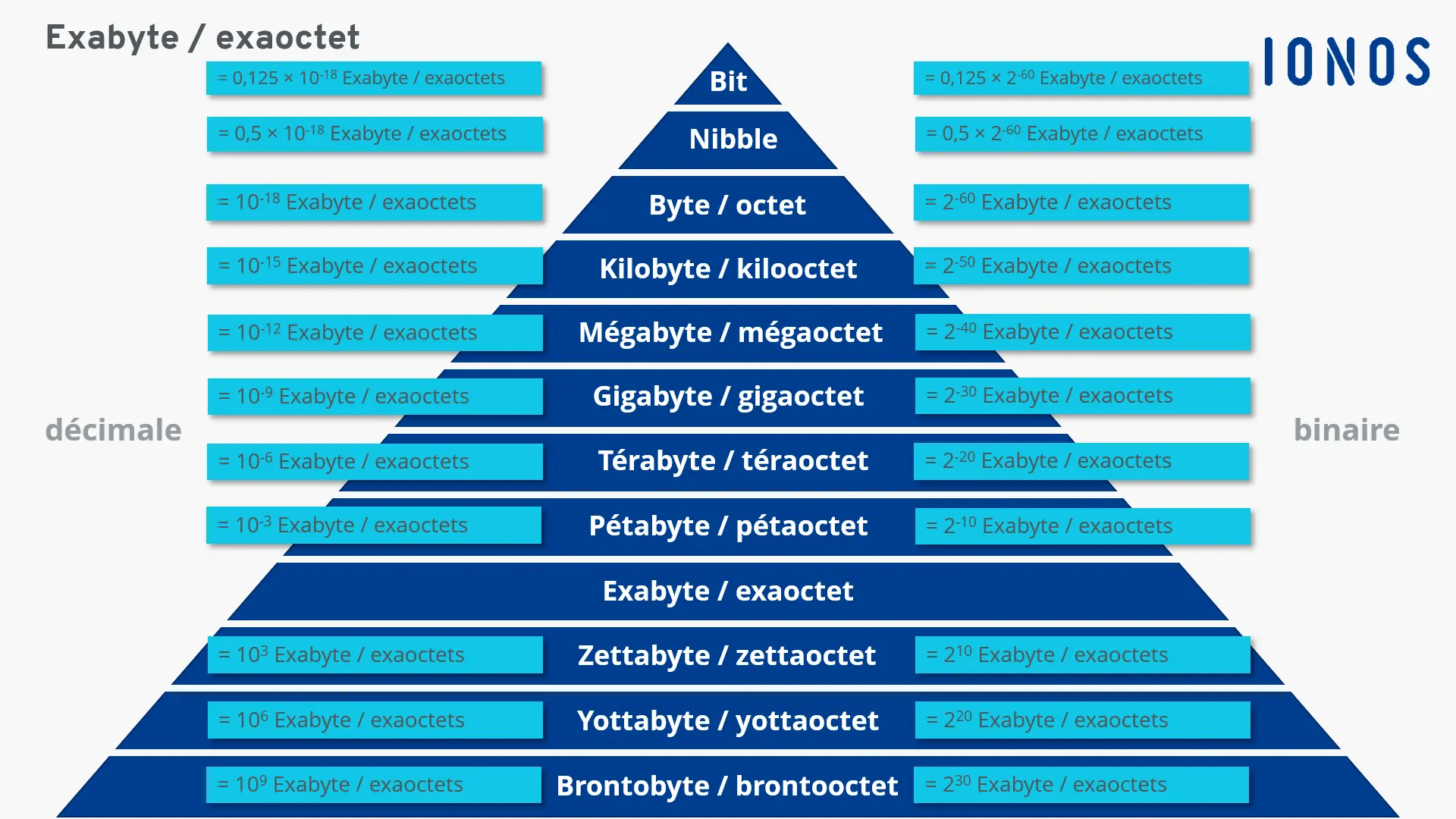
According to the decimal system, an exabyte corresponds to 1018 bytes, that is to say a trillion bytes. A megabyte is made up of one million bytes. As a reminder, a high resolution photo weighs approximately 4 MB.
Globally, the total volume of data created, copied or consumed is now measured in zettabytes (1021 bytes). This far exceeds the quantities of data that we handle individually, but clearly illustrates the explosion in the volume of digital information. To better represent these orders of magnitude: 1024 terabytes are 1 petabyte, and 1024 petabytes correspond to 1 exabyte.
Noticed
In everyday life, the amounts of data we deal with are never less than 1 byte. But there is actually an even smaller amount of data: the quartet, also known as nibble. A nibble contains 4 bits and is primarily used in 4-bit computer architectures and protocols.
Exabyte compared to other amounts of data
Computer units of measurement exist in two standards: binary and decimal. The binary prefix standard is recommended by the IEC (International Electrotechnical Commission) because it more accurately represents storage capacities and is better suited to data carriers. The decimal prefix standard based on the SI (International System of Units) is currently the most widespread, but it gives approximate values. The fact that decimal prefixes are also used for binary quantities often leads to confusion. However, binary prefixes are not yet widely used in common usage.
| Binary prefix (IEC) | In bytes/bytes + conversion factor |
|---|---|
| Kibibyte (KiB) or Kibibyte (KiB) | 1,024 (210) |
| Mebibyte (MiB) or Mebibyte (MiB) | 1,048,576 (220) |
| Gibibyte (GiB) or Gibibyte (GiB) | 1,073,741,824 (230) |
| Tebibyte (TiB) or Tebioctet (Tio) | 1,099,511,627,776 (240) |
| Pebibyte (PiB) or Pebibyte (Pio) | 1,125,899,906,842,624 (250) |
| Exbibyte (EiB) or Exbioctet (Eio) | 1,152,921,504,606,846,976 (260) |
| Zebibyte (ZiB) or Zebioctet (Zio) | 1,180 591 620 717 411 303 424 (270) |
| Yobibyte (YiB) or Yobioctet (Yio) | 1 208 925 819 614 629 174 706 176 (280) |
Create a website
Your site in a flash thanks to artificial intelligence
- Intuitive site editor with AI features
- Image and text generator with SEO optimization
- Domain, SSL and email included
| Decimal prefix (SI) | In bytes/bytes + conversion factor |
|---|---|
| Kilobyte (KB) or Kilobyte (KB) | 1,000 (103) |
| Megabyte (MB) or Megabyte (MB) | 1,000,000 (106) |
| Gigabyte (GB) or Gigabyte (GB) | 1,000,000,000 (109) |
| Terabyte (TB) or Terabyte (TB) | 1,000,000,000,000 (1012) |
| Petabyte (PB) or Petabyte (PB) | 1,000,000,000,000,000 (1015) |
| Exabyte (EB) or Exabyte (Eo) | 1,000,000,000,000,000,000 (1018) |
| Zettabyte (ZB) or Zettabyte (Zo) | 1,000,000,000,000,000,000,000 (1021) |
| Yottabyte (YB) or Yottabyte (Yo) | 1,000,000,000,000,000,000,000,000 (1024) |
Noticed
A simple comparison to illustrate exabytes: if the Earth represents one megabyte, then the Sun represents one exabyte. A little closer to everyday life: it would take a video call of 237,823 years to obtain an exabyte. Movie buffs, for their part, could store around eleven million films in HD (depending on the format used) on a memory of one exabyte.