
THE load balancing Allows you to distribute access to the server evenly between several servers using a load distributor (load swing) placed upstream. Thus, stable access times are guaranteed, which is essential to generate prospects and customers.
Virtual servers (VPS)
Choose performance
- Complete virtualization with root access
- Unlimited traffic and up to 1 Gbit/s of bandwidth
- Quick NVME SSD storage and Plesk Web Host edition
What is load balancing?
Load Balancing, or distribution of loads, is particularly popular in the field of servers technology and describes a process in which requests are distributed in the background between different serverswithout users noticing. The LOAD BALANCER (load distributor) used for this purpose can be implemented in hardware or software form. It allowsassociate several servers with the same areawithout there being any addresses and is accessible under the public domain.
Note
Normally, each area is assigned to a single web server. If it breaks down due to an overload, the user receives a HTTP status code: the website cannot be displayed.
Secondary web servers are often identified by sub-domains such as www1,, www2,, www3etc. Load Balancing makes a website available under the same URL, even if several servers are hidden behind. This lightens the load of a server since the request from the outside is distributed on several computers within a cluster.
Load Balancing can also play a role outside web servers, for example on multiple processor computers. In this case, the LOAD BALANCER provides a Uniform distribution of needs Between the different processors in order to generate more computing power. In addition, LOAD BALANCES are popular for the use of containerization software like Kubernetes. They take care here that the workloads are distributed judiciously between different pods.
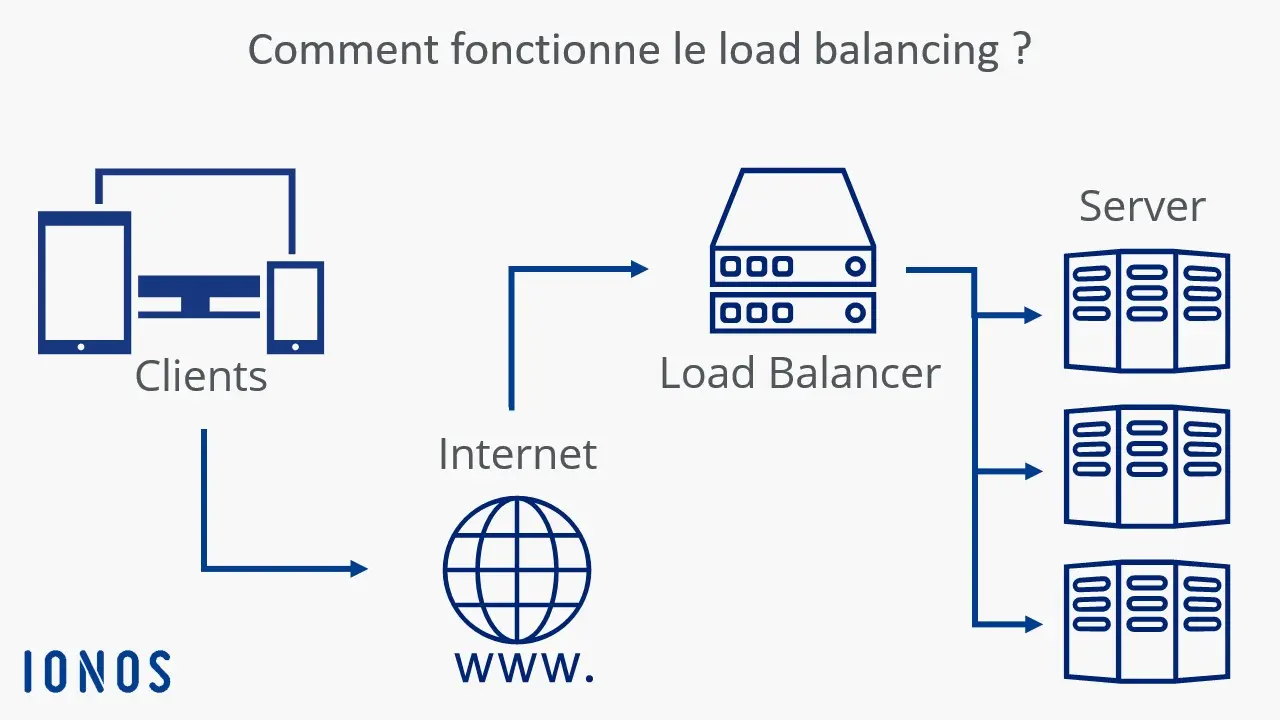
Requests to a web server, for example in the form of loading a page, first run on the LOAD BALANCER. This then supports the distribution of the load by transferring access to the various servers. The lumping can be hardware or softwarebut the principle remains the same: a request reaches it and, depending on the method used, the device or software transmits the data to the appropriate server.
The technical base is the DNS process : users access a website only via an URL. The site is then converted using the DNS into an IP address, which in turn refers to the LOAD BALANCER.
The advantages of a balanced load balancing
The main advantages of a good distribution of loads are as follows:
- Optimized access times : the distribution of traffic on several servers makes it possible to reduce access times, even during numerous simultaneous requests.
- Greater reliability : A LOAD BALANCER guarantees better protection against breakdowns, since traffic from a too slow server is automatically transferred to other cluster servers. Even if a server is not accessible, the accommodated website remains available.
- Simplified system maintenance : Configurations and updates can be performed during the operation of the servers, without significant loss of performance. The LOAD BALANCE detects the maintenance state and redirects the requests accordingly.
Web accommodation
Flexible, efficient and safe web accommodation
- SSL certificate and DDOS protection
- Data backup and restoration
- Assistance 24/7 and personal advisor
The different Load Balancing methods
The way in which incoming requests are distributed depends on the choice of algorithm. THE popular algorithms For the LOAD BALANCING are: Round Robin, Weighted Round Robin, Least Connections and Weighted Least Connections.
Round Robin
Round Robin designates a cyclic process in which the requests for incoming servers are managed by the LOAD swing in a sort of queue and distributed to servers in series. Each new request is assigned to the following server in the queue in order to distribute the access uniformly over the Load Balancing cluster. In the Round Robin process, all the processes are treated equally, regardless of the urgency of the server or the load of the server which generates it. A LOAD BALANCER operating according to this principle is therefore particularly suitable for the environments in which all the instances have roughly the same resources.
Weighted Round Robin
The weaknesses of the classic Algorithm of the Robin Round in the heterogeneous servers clusters can be compensated by a balanced Robin Robin distribution. The incoming requests are distributed taking into account the static weighting of the different servers. This weighting is defined beforehand by the administrator.
The most efficient server can thus be assigned the value « 100 », while the less effective servers receive the value « 50 ». In such a configuration, the weighted server « 100 » would receive two LOAD requests for each turn, while the weighted server « 50 » would receive only one request. The Weighted Round Robin must be used mainly for charging balancing when the servers connected to the cluster have different resources.
Least Connections
During the distribution of server queries, the Round Robin algorithms mentioned above do not take into account the number of connections already active on each server. It can therefore happen that a server is overloaded, even if it was less requested at the start. The Least Connections algorithm corrects this problem by assigning each new request to the server which currently has the least active connections. This method is particularly suitable for homogeneous clusters, in which servers have similar resources.
Weighted Least Connections
If a server cluster has different capacities, it is necessary to use, instead of the Least Connections algorithm, a low -balanced LOAD Balancing method according to existing connections. This makes it possible to take into account both the number of active connections of a server and the weighting defined by the administrator. Thus, a balanced distribution of the load within the server cluster is guaranteed. The new requests are automatically assigned by the LOAD swing to servers whose ratio between active connections and the respective weighting of the server indicates the lowest current load.
What problems can arise when using load balancing?
L'E-commerce is particularly confronted with Load Balancing problems, for example when visitors to a website fill their basket with the items they want to buy. These items remain saved for the duration of a session, regardless of the page consulted by users on the online store. A LOAD BALANCE NORMAL would distribute the requests between different servers, but that would result in the loss of the basket.
Two approaches are possible to solve this problem. First, the LOAD BALANCER can React to the IP address user. The distributor then always sends requests from the same IP address to the same server. Another method is to Read a session identifier In the request itself to determine which server it should be redirected.
Why are LOAD BALANCES so important?
If you make money on the Internet, your business cannot afford a server failure. And if you use only one server and it breaks due to an overload, your website is no longer accessible to potential customers. This leads to several problems: on the one hand, you cannot generate any turnover during the overload. Indeed, the services cannot be reserved and purchases cannot be made. On the other hand, The confidence of your potential customers also decreases. Users who meet overload of the server during the control process are doubly penalized. Often there is a great uncertainty and the persons concerned do not know if the order has really arrived in the system and if it has been recorded.
But even if you do not offer online services, your website must be accessible at any time. It is indeed one of the main information channels about your company: if customers are looking for information but fail to access your site, they will turn to competitors. A LOAD BALANCER allows you to minimize these risks.
Set up the lOad Balancing in your business
Load Balancing can be set up on a virtual server using hardware or software solutions. Many suppliers offer Complete professional packs in the form ofInfrastructure-as-a-service (IAAS) or network components for your IT infrastructure.
The acquisition of LOAD Balancers owners is generally expensive, small businesses often use open source solutions such as Nginx. This is an economical solution to ensure the high availability of your company's website thanks to an effective distribution of the load within the server network. In the field of web accommodation, the LOAD BARNCING can also be offered as an additional functionality for cloud servers.